The scorecard
8.9/10 · Essential
- Songwriting25%
- 9.0
- Production25%
- 9.5
- Performance15%
- 9.0
- Cohesion15%
- 7.5
- Originality10%
- 8.5
- Replay value10%
- 9.0
Seven of nine songs built for singles, each with a distinct melodic hook and a chorus engineered to stick, from the falsetto lift in Billie Jean to the rock chant in Beat It.
Quincy Jones and engineer Bruce Swedien craft a record where every element serves the song: the long Billie Jean intro that makes Jackson want to dance, Eddie Van Halen's solo slicing through Beat It, Vincent Price's growl closing Thriller.
Jackson moves from the breathy falsetto in Human Nature to the low growl opening Wanna Be Startin' Somethin', controlling tone and character with the precision of someone who knows exactly what each song needs.
Nine tracks in 42 minutes with no filler, though the ballad cluster at the end (Human Nature, P.Y.T., The Lady in My Life) softens the momentum built by the Billie Jean to Beat It peak.
Post-disco synth-pop built with rock guitar and paranoid lyrics at a moment when the industry had written off dance music, opening a lane no one else was driving in 1982.
Four decades on, the album holds because the songs were constructed to last: hooks that survive overexposure, production choices that define their era without dating the songs.
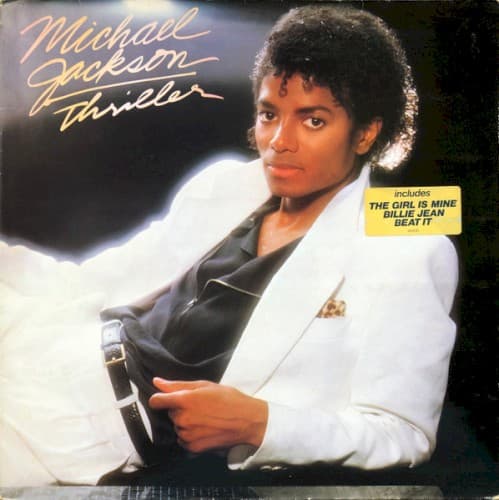
Michael Jackson Thriller — Pop Builds a Whole Album of Singles
Michael Jackson told Quincy Jones he wanted an album where every song was a single, where nothing felt like a B-side filling space between the hits. Thriller delivers on that ambition with a focus that reshapes what a pop album could be in 1982. Nine tracks, no skits, no throwaway album cuts, each song built with the craft and budget usually reserved for lead singles. The result is a record engineered for total market penetration: rock radio gets Beat It with Eddie Van Halen's solo, adult contemporary gets The Girl Is Mine with Paul McCartney, R&B gets Billie Jean's paranoid funk, and the title track gives MTV a horror-movie event. The album works because Jackson and Jones understood that mainstream pop in 1982 meant building a record that could move across format boundaries that were hardening as disco collapsed and rock radio closed ranks.
The thesis is not that Thriller is flawless but that it executes a specific commercial strategy with uncommon discipline. Jackson wanted to be the biggest star in the industry after Off the Wall sold seven million copies and lost Album of the Year at the Grammys. He saw that loss as proof the industry undervalued black artists, and he built Thriller to be obvious on the industry's own terms: singles, videos, awards, sales. The album is not an artistic statement that happens to sell; it is a commercial blueprint that happens to contain great songs. That distinction matters because it explains both the album's strengths and its limits. Thriller succeeds by being exactly what it set out to be, which is why it dominated 1983 and 1984 but also why its second half sags under the weight of its own competence.
The Post-Disco Formula Rebuilt for Maximum Range
Thriller solves the problem of how to make a pop record in 1982 when disco is dead and radio is fragmented. Jones and Jackson recorded 30 songs and picked nine, each aimed at a different audience. The production budget was three-quarters of a million dollars, high for the time, and the money shows in the density of the arrangements and the clarity of the mix. Bruce Swedien's engineering gives every element space: the bass and drums open Billie Jean with four bars of locked groove before anything else enters, and that choice makes the song move. Swedien recorded Jackson's vocal for Billie Jean through a six-foot cardboard tube to get the right resonance, and he brought in jazz saxophonist Tom Scott to play a wind-controlled synthesizer called a lyricon. These are not accidents; they are decisions made by professionals with time and resources to get the sound right.
The songwriting is functional and effective. Jackson wrote four of the nine tracks — Wanna Be Startin' Somethin', The Girl Is Mine, Beat It, Billie Jean — and Rod Temperton wrote three others, including Thriller and P.Y.T. The songs follow verse-chorus structures with bridges that lift into the final chorus, and the hooks are immediate. Beat It rides a rock riff and a gang-violence lyric softened enough for radio; Billie Jean builds tension through repetition and a bassline that never resolves; Wanna Be Startin' Somethin' climaxes in an African-inspired chant that gives the song an international flavor without requiring any specific cultural knowledge. The writing is competent across the board, but only Billie Jean and Beat It feel essential. The rest are well-made album tracks that benefit from the production.
Jackson's vocal performance is the album's main variable. He can sing low, down to a basso low C, but he chooses to stay in a higher register because pop tenors have more range to create style. He uses falsetto as a texture, not a gimmick, and his phrasing is precise. On Human Nature he floats over Steve Porcaro's synth arrangement with a dreamy delivery that matches the lyric; on Thriller he shifts into character for the spoken bridge and lets Vincent Price handle the horror-movie narration. The vocal hiccup he started using in 1973 appears throughout the album as a way to convey emotion, a gulping gasp that signals excitement or fear depending on the song. It is a technique that becomes a trademark, and it works because Jackson controls it.
The album's main weakness is that it plays it safe. The Girl Is Mine is a duet with Paul McCartney that ends with a polite rap, and it sounds exactly like the compromise it is: an attempt to court a white audience that critics immediately called out as too soft. Baby Be Mine and The Lady in My Life are competent R&B ballads that would be standouts on a lesser album but here feel like they are marking time. Jackson and Jones were determined to make a record that would win awards and cross formats, and that ambition sometimes flattens the material. The paranoia and darkness that define Billie Jean and Thriller are missing from the album's middle section, and the result is an album that peaks early and coasts.
A Front-Loaded Sequence That Loses Momentum After Beat It
Thriller is sequenced for radio and retail, not for flow. The album opens with six minutes of escalating tension that climaxes in a chant, then drops into a mid-tempo groove that feels like a cooldown. A soft, safe duet follows, before the album pivots into its peak: a three-song run of horror theatrics, rock crossover, and paranoid funk. That stretch is the record's core, and it works because each song delivers a different kind of intensity.
After the peak the album shifts into ballads: one moody and effective, conveying loneliness without sentimentality, followed by two that are well-produced, well-sung, and too polite to justify their placement. The sequencing makes sense for an album designed to generate singles across formats, but it undercuts the record's momentum. The album builds to its best moment and then unwinds, and the final two tracks feel like the record is filling time rather than earning its 42-minute runtime.
The Best-Selling Album Ever Made, Built to Be Exactly That
Thriller is the most successful album in the history of recorded music because it was engineered for that outcome. Jackson wanted to be the biggest star in the industry, and he and Jones made a record that could dominate every format: rock, pop, R&B, adult contemporary. The album won eight Grammys, spent 37 weeks at number one, and generated seven top-ten singles. It made Jackson the most famous entertainer in the world and proved that a black artist could break through barriers the industry had spent decades enforcing. That success is not incidental to the album's design; it is the point.
The album works best for listeners who want pop songs built to last. The three biggest hits are as good as pop gets in the early 1980s, and the moodiest ballad is strong. The rest of the album is solid, sometimes great, never weak. Start with the paranoid funk track, then the rock crossover, then the title cut. If those three work, play the whole album. If you want more, Off the Wall is looser and more disco-forward, while Bad pushes the paranoia and production further.
Thriller is not Jackson's most adventurous album, but it is his most complete execution of a commercial vision, and that clarity of purpose is why it still moves units 40 years later.
Track by track
Track Listing
Wanna Be Startin’ Somethin’
StandoutSix minutes of escalating paranoia that opens the album with a statement of intent. The bassline locks into a funk groove and never lets go, building tension through repetition as Jackson sings about gossip and media pressure. The lyric is vague enough to apply to anyone, specific enough to feel personal. The song climaxes in an African-inspired chant, syllables based on Duala that give the track an international flavor without requiring translation. The chant works because it provides release after five minutes of tension, and it signals that this album will take risks. The song is too long by 90 seconds, but the excess feels deliberate, a flex that says the album can afford to spend time on one idea.
Baby Be Mine
SolidA mid-tempo R&B groove that smooths out the intensity of the opener. The production is clean, the vocal is controlled, and the song does its job without making a case for itself. It is filler by the album's own standard, though on most other records it would be a solid album track.
The Girl Is Mine
WeakThe Paul McCartney duet that critics immediately identified as a mistake. The song is too soft, too safe, and the closing rap feels like a gimmick. It topped the Hot Black Singles chart and reached number two on the Hot 100, proving that the market would accept Jackson courting a white audience, but it remains the album's weakest moment. McCartney's presence adds nothing, and the song's politeness undercuts the tension the album builds everywhere else.
Thriller
StandoutRod Temperton wrote the song as a novelty, originally titled Starlight or Midnight Man, and settled on Thriller because he thought the name had merchandising potential. The song delivers on that premise: creaking doors, thunder, footsteps, howling dogs, and Vincent Price reciting a spoken horror-movie monologue that Temperton wrote in a taxi on the way to the studio. Price recorded his part in two takes, and his voice gives the track a camp seriousness that makes it work. The music video became the most famous music video of all time, and the song itself is a well-executed genre exercise, a Halloween single that plays every October because it commits to the bit. The production is dense, the vocal is character-driven, and the song succeeds because it knows exactly what it is.
Beat It
StandoutJackson's first successful rock crossover, built around Eddie Van Halen's guitar solo and a lyric about walking away from gang violence. Jones and Jackson spent weeks looking for the right guitarist and eventually cast Steve Lukather of Toto on rhythm guitar and Van Halen on the solo. Van Halen's solo is the song's signature, a 20-second eruption that cuts through the synth-pop production and gives rock radio a reason to play the track. The lyric is West Side Story softened for pop radio, and the message is clear enough to survive the softening: you do not have to fight to prove you are a man. The song works because it delivers on its premise without apology, and the production is muscular enough to support the rock elements without sounding like pastiche.
Billie Jean
StandoutThe album's best song, a paranoid funk track about an obsessive fan who claims Jackson fathered her child. The song opens with a four-bar bass-and-drums introduction that establishes the groove, and nothing breaks the tension for the next five minutes. Jackson insisted on keeping the long intro because it made him want to dance, and he was right: the intro is the song's foundation, the space that lets the vocal and the bassline lock in. The production is precise: Jackson sang overdubs through a six-foot cardboard tube, Tom Scott played lyricon, and bassist Louis Johnson ran his part on a Yamaha bass. The vocal is controlled, the falsetto is used for texture, and the hiccup appears as a rhythmic device. The song topped the Hot 100 for seven weeks, topped the Hot Black Singles chart for nine, and became Jackson's best-selling solo single. It is the reason the album works, the track that justifies the hype and the strategy.
Human Nature
StandoutSteve Porcaro of Toto co-wrote the song, and it is the album's most introspective moment. The lyric conveys loneliness without sentimentality, and Jackson's vocal floats over the synth arrangement with a dreamy delivery that matches the mood. The song reached number seven on the Hot 100 and number two on the Adult Contemporary chart, and it remains one of Jackson's most covered tracks. It works because it gives the album a moment of quiet, a pause before the final two songs.
P.Y.T. (Pretty Young Thing)
SolidA James Ingram and Quincy Jones track that gives the album a stronger R&B direction. The production is tight, the vocal is playful, and the song does its job without standing out. It charted at number ten on the Hot 100, and it is fine. On a lesser album it would be a highlight; here it is a well-made album track that the album does not need.
The Lady in My Life
SolidRod Temperton's ballad, described as the closest Jackson came to crooning a sexy, soulful ballad after his Motown years. The vocal is controlled, the production is lush, and the song is too polite to close an album that started with paranoia and tension. It is a competent closer that undermines the album's momentum.