The scorecard
9.3/10 · Essential
- Songwriting25%
- 9.5
- Production25%
- 10.0
- Performance15%
- 8.0
- Cohesion15%
- 9.0
- Originality10%
- 9.5
- Replay value10%
- 9.0
Every song earns its lift through melody and structure rather than repetition, with hooks built from chord motion and countermelody instead of slogans.
The orchestrations serve the songs without overwhelming them, layering found sounds and classical instruments into arrangements that still function as pop records.
Brian Wilson's lead vocals carry the vulnerability the lyrics require, though Mike Love's nasal tone on "Here Today" and "I Know There's an Answer" weakens two otherwise strong tracks.
The sequencing moves from longing to resignation without filler, though "Sloop John B" disrupts the album's introspective arc as the one track that predates the Pet Sounds sessions.
Wilson turned Phil Spector's Wall of Sound into a compositional method rather than a production trick, making instruments like bass harmonica and bicycle horn function as melodic voices.
The arrangements reveal new details on repeat listens, from the arch-shaped motifs in "Don't Talk" to the chromatic bass lines that anchor even the most harmonically complex songs.
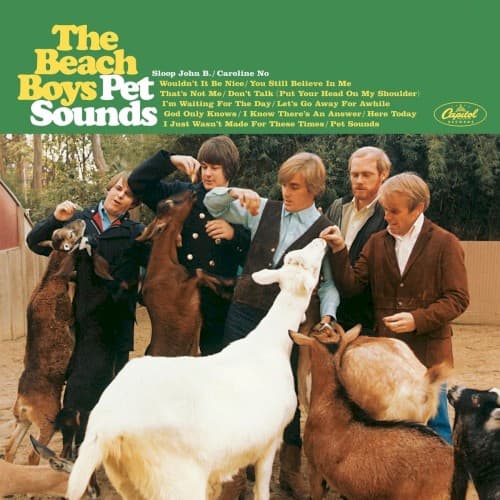
The Beach Boys Pet Sounds — Pop Learns to Build Albums Like Symphonies
Pet Sounds answered a question no one in pop had asked clearly before 1966: what happens when you arrange every song on an album with the same care a composer gives a suite, letting the production itself carry as much emotional weight as the lyrics. Brian Wilson heard the Beatles' Rubber Soul and decided to make a record where every track mattered and none existed just to fill space between singles. He succeeded by turning Phil Spector's Wall of Sound from a singles technique into an album-length method, layering bicycle horns and Coca-Cola cans and Electro-Theremin into orchestrations that function as countermelodies rather than decoration. The result is a set of songs about growing older and losing certainty, arranged so that the music itself enacts the instability the words describe.
Wilson composed Pet Sounds with Tony Asher over three weeks in early 1966, then recorded it with session musicians from the Wrecking Crew while the rest of the Beach Boys toured. The album cost over $70,000 to produce, an unprecedented figure at the time, and it represents the first instance of a rock group abandoning the small-ensemble format for an entire LP. The orchestrations blend pop, jazz, exotica and classical elements, not by grafting strings onto rock songs but by rethinking what a pop arrangement could do. Wilson used block chords and polytonal stacking instead of horizontal classical structures, wrote bass lines that avoid the root note, and employed instruments like French horn and tack piano as melodic voices rather than texture. The album peaked at number 10 in the U.S. and number 2 in the UK, where critics immediately recognized it as something new. It has since become one of the most cited influences in pop history, credited with elevating the album format and establishing the studio as a compositional tool.
How Wilson Turned the Wall of Sound Into a Compositional Language
Wilson's orchestrations on Pet Sounds adapt classical instrumentation to pop rather than superimposing one onto the other. Tracks average a dozen unique instruments, from ukulele and accordion on "Wouldn't It Be Nice" to bass harmonica and güiro on "You Still Believe in Me". He employs doubling extensively—two instruments playing the same melody—a technique common in orchestral music but rare in rock beyond electric bass. Violins and accordions double each other, electric and acoustic basses play the same line with a hard plectrum, and the result is a thicker, more dimensional sound than Spector achieved by layering the same instruments in unison. The rhythm section works less for backbeat than for texture and tone, with drums appearing as color rather than steady pulse.
The vocal harmonies are fewer but more complex than on earlier Beach Boys records, sometimes employing counterpoint and doo-wop nonsense syllables that function as additional instruments. "God Only Knows" stacks Carl Wilson's lead with Brian Wilson and Bruce Johnston in harmonies that shift through multiple keys without establishing a tonal center, while "Don't Talk (Put Your Head on My Shoulder)" uses ascending stepwise vocal phrases mirrored by instrumental responses in an arch-shaped motif that recurs throughout the album. Wilson's harmonic vocabulary draws on slashed, diminished, major seventh, sixth and suspended chords, with every track in a major key despite the album's emotional content. "You Still Believe in Me" sits in B, a key with numerous sharps and flats that keyboardists typically avoid, and "That's Not Me" is in F♯, the key farthest from C.
Wilson worked with Asher on eleven of the thirteen tracks, with Asher providing feedback on melodies and chord progressions and writing most of the actual words from Wilson's lyrical ideas. The songs explore introspection and disillusionment rather than the cars and surfing that defined the Beach Boys' earlier work, with Wilson drawing from his marital struggles and his experiences with LSD to shape the emotional content. The narrator of "Wouldn't It Be Nice" wishes to be older so marriage would arrive sooner, a direct inversion of the group's earlier celebrations of adolescence. "I Know There's an Answer", co-written with road manager Terry Sachen, critiques LSD culture despite Wilson's own use of the drug. "I Just Wasn't Made for These Times" addresses social alienation in plainspoken terms.
The album's main weakness is that Mike Love's nasal delivery works against the vulnerability the lyrics require. His lead on "Here Today" and shared lead on "I Know There's an Answer" flatten songs that demand the emotional transparency Brian Wilson brings to "Don't Talk" and "Caroline, No". "Sloop John B", a leftover from earlier sessions that Wilson completed for the album, disrupts the arc from longing to resignation with a tempo and subject matter that belong to the group's pre-1965 sound. The track is well-crafted but feels like an intrusion from a different record.
How the Album Moves From Optimism to Resignation Without Filler
Pet Sounds sequences its songs to trace a progression from youthful optimism to emotional disillusionment, though Wilson and Asher never planned a specific narrative. The album opens with a song about wanting to be older and closes with a song about loss and time passing, and the eleven tracks between them enact the transition. The first side moves from bright orchestration through self-doubt to quiet intimacy, then shifts to an instrumental track originally recorded as a backing for a vocal song but left instrumental because Wilson decided it worked better that way. The second side contains the album's strongest sequence. A hymn-like love song sits at the center, with Carl Wilson's lead vocal and an arrangement that layers French horn, strings and sleigh bells into a texture that never settles into a single key. The middle section features an Electro-Theremin line that anticipates the theremin's use in psychedelic rock and a lyric that addresses alienation without self-pity. The instrumental "Pet Sounds" arrives near the end, a two-minute piece built from the same arch-shaped motifs and chromatic bass lines that unify the album. The sequencing earns its 36-minute length without sag, though "Sloop John B" remains the one track that could be removed without weakening the whole.
The Album That Made Pop Take Itself Seriously as an Art Form
Pet Sounds ranks as the most influential Beach Boys album and one of the most important pop records of the 1960s. It established the album as a cohesive work rather than a collection of singles and filler, and it proved that orchestral pop could function as a compositional method rather than a production flourish. The album influenced the Beatles' Sgt. Pepper's Lonely Hearts Club Band, which Paul McCartney has cited as a direct response, and it contributed to the development of baroque pop, progressive rock, soft rock and psychedelia. Wilson's use of the studio as a compositional tool and his willingness to replace the band with session musicians on the backing tracks changed how pop records were made.
The album is for listeners who want to hear how orchestral pop learned to build complex arrangements that still function as pop songs, and for anyone interested in the moment when rock albums became works that reward full listens rather than just delivering singles. It is not for listeners who prefer the Beach Boys' earlier surf and car songs, or for those who find introspective lyrics about relationships and aging too downbeat. The production can sound overly sweet to ears trained on punk or hip-hop, and the lack of a steady backbeat on many tracks will frustrate listeners who want rock rhythm.
Start with "God Only Knows", the album's clearest statement of Wilson's orchestral ambitions, then move to "Wouldn't It Be Nice" for the opening argument and "Caroline, No" for the closing resignation. Skip "Sloop John B" if you want the album's introspective arc without interruption. After Pet Sounds, listen to The Beach Boys Today! to hear the second side that anticipates this album's sound, then move to the Beatles' Rubber Soul to hear the record that provoked Wilson to attempt something this ambitious. Pet Sounds has aged into a document of what pop could do once it decided to build albums with the same care it gave singles, and it remains the clearest example of how orchestration can carry as much emotional weight as words.
Track by track
Track Listing
Wouldn’t It Be Nice
StandoutThe opening track makes its argument in the first verse: growing up means access to commitment, and the narrator wants that more than youth. Wilson and Mike Love share the lead vocal over an arrangement that layers accordion, sleigh bells and mallet percussion into a bright texture that contrasts with the lyric's longing. The chorus lifts through a chord change that moves to the subdominant rather than the dominant, a choice that keeps the resolution from arriving and sustains the feeling of wanting something just out of reach. The harpsichord line in the bridge functions as a countermelody rather than decoration, and the song ends without fadeout, cutting off cleanly after the final chorus. The production is dense but never cluttered, with each instrument occupying its own frequency range.
You Still Believe in Me
StandoutA song about self-awareness of flaws, written in the key of B to force Wilson into unusual chord voicings that suit the lyric's instability. The intro features plucked piano strings and Marilyn Wilson's backing vocal, a found sound that recurs as punctuation throughout the verse. The melody moves in ascending stepwise phrases that receive mirrored instrumental responses, an arch-shaped motif that appears on multiple tracks. Wilson's lead vocal carries the vulnerability the lyric requires, with his phrasing stretching certain words to emphasize doubt. The bicycle horn that appears in the bridge sounds absurd in isolation but functions as a melodic voice in context, a choice that exemplifies Wilson's approach to orchestration throughout the album.
That’s Not Me
SolidThe one track where the Beach Boys play their own instruments, with Carl Wilson on Rickenbacker 12-string and Fender Stratocaster and Brian Wilson on Fender bass. The song sits in F♯, the key farthest from C, and moves between that key and another without returning to where it started, a structural choice that mirrors the lyric about trying to be someone you're not and failing. Mike Love takes the lead vocal with Brian Wilson joining on harmonies, and the arrangement is sparser than the surrounding tracks, relying on tambourine and handclaps for rhythm. The simplicity works as a contrast to the album's denser orchestrations, though the track feels slight compared to what surrounds it.
Don’t Talk (Put Your Head on My Shoulder)
StandoutAn intimate ballad with one of Wilson's most controlled lead vocals, delivered in a near-whisper over strings and woodwinds. The arrangement uses ascending vocal phrases mirrored by instrumental responses, the same arch-shaped motif from "You Still Believe in Me", and the song employs half-diminished seventh chords to create tension on the word "eyes" in the line "I can see so much in your eyes". The bridge introduces French horn and bass flute, instruments that had appeared on The Beach Boys Today! but were still rare in rock. The song avoids a traditional backbeat, with the rhythm section providing texture rather than pulse. The lyric asks for silence and physical closeness instead of conversation, and the sparse arrangement enacts that request.
I’m Waiting for the Day
SolidA co-write with Mike Love that extends a verse-refrain structure through three repetitions before concluding with unrelated thematic material, a formal choice that mirrors the lyric about waiting for reciprocated love. Wilson takes the lead vocal over an arrangement that features vibraphone and tack piano, and the song sits in E, one of the four tracks with a strongly established key. The outro section shifts the mood without resolving the narrative, leaving the question of whether the waiting pays off unanswered. The production is solid but the song lacks the melodic hooks of the album's stronger tracks.
Let’s Go Away for Awhile
StandoutAn instrumental originally recorded as a backing track for a vocal song, which Wilson decided worked better without words. The piece moves from one key to another without returning to the starting point, and it features a vibraphone progression in the second half that employs the album's recurring arch-shaped motif. The arrangement layers accordion, strings and percussion into a texture that remains transparent despite the number of instruments. The track functions as a palette cleanser before "Sloop John B", and its two-minute length is exactly what the album needs at this point in the sequence. The title suggests escape, which the music enacts through its refusal to resolve.
Sloop John B
SolidA traditional folk song that Wilson began recording in 1965 and completed for Pet Sounds without consultation with Asher. The track sits in A♭ and features a straightforward verse-chorus structure with a tempo and subject matter that belong to the Beach Boys' pre-1965 sound. Brian Wilson and Mike Love share the lead vocal, and the arrangement includes accordion and glockenspiel in a production that is well-crafted but disrupts the album's introspective arc. The song was issued as a single and became a hit, which may explain its inclusion, but it feels like an intrusion from a different record. Al Jardine contributed to the arrangement but remains uncredited.
God Only Knows
StandoutThe album's peak and one of the most harmonically complex pop songs of the 1960s. Carl Wilson takes the lead vocal with Brian Wilson and Bruce Johnston providing harmonies that shift through multiple keys without establishing a tonal center, and the arrangement layers French horn, strings, sleigh bells and accordion into a texture that never settles. The song employs half-diminished seventh chords to create tension on the words "sure about it" and "livin' do me", and the bass line avoids the root note to maintain harmonic instability. The production is dense but transparent, with each instrument occupying its own space. The lyric is a love song framed as a hymn, and the music matches that tone without tipping into sentimentality. The track represents Wilson's orchestral ambitions at their clearest and most successful.
I Know There’s an Answer
SolidA critique of LSD culture co-written with road manager Terry Sachen, despite Wilson's own use of the drug. Mike Love, Al Jardine and Brian Wilson share the lead vocal, with Love's nasal tone flattening a song that requires more emotional range. The arrangement features Hammond organ and tambourine in a production that is brighter than the surrounding tracks, and the song uses the album's recurring arch-shaped motif in the concluding organ phrase. The lyric addresses people who "trip through the day and waste all their thoughts at night" without moralizing, and the music avoids matching the condescension in the words. Mike Love received retroactive co-writing credit in 1994, though his contributions beyond arrangement ideas are disputed.
Here Today
SolidA song about the impermanence of love, with Mike Love taking the lead vocal over an arrangement that features tack piano and strings. The track sits in a straightforward verse-chorus structure and employs a descending 1–5 bass pattern that Wilson had used on earlier albums and revived for Pet Sounds. Love's delivery lacks the vulnerability the lyric requires, and his nasal tone works against the song's emotional intent. The production is solid, with the Wegman tack piano providing a bright tone that contrasts with the melancholy subject matter, but the vocal performance weakens what could have been a stronger track.
I Just Wasn’t Made for These Times
StandoutA song about social alienation with one of Wilson's most transparent lead vocals, delivered over an arrangement that features Electro-Theremin, an instrument that anticipates the theremin's use in psychedelic rock. The song sits in B♭ and employs a descending 1–5 bass pattern, and the lyric addresses feeling out of step with the world without self-pity. The Electro-Theremin line functions as a melodic voice rather than an effect, weaving through the verses and chorus in a way that supports the vocal without competing with it. The production is spare compared to the album's denser tracks, and the song benefits from the restraint. Asher cited significant musical contributions to this track in later interviews.
Pet Sounds
StandoutAn instrumental that shares its name with the album, originally recorded as a backing track but left without vocals. The piece employs the same arch-shaped motifs and chromatic bass lines that unify the album, and it features a descending 1–5 bass pattern over an arrangement that layers percussion, strings and woodwinds. The track sits in a two-section structure without repetition, and the production emphasizes the found sounds and unusual timbres that characterize Wilson's approach throughout the record. The dogs that bark in the outro—Banana the Weimaraner and Louie the Beagle—provide a transition to "Caroline, No" and a moment of levity before the album's closing statement.
Caroline No
StandoutThe album's conclusion and its most plainly sad song, with a lyric about loss and time passing over an arrangement that features bass harmonica and strings. Wilson takes the lead vocal, and his delivery is more fragile than on any other track, with his voice cracking slightly on certain phrases in a way that serves the material. The song was issued as Wilson's official solo debut single, and it closes the album by enacting the resignation the sequencing has been moving toward since "Wouldn't It Be Nice". The production ends with the sound of a passing train and more barking dogs, found sounds that function as a coda for the entire record. Marilyn Wilson felt the song addressed their marriage directly, and the specificity in the lyric supports that reading.