The scorecard
8.3/10 · Great
- Songwriting25%
- 8.5
- Production25%
- 9.0
- Performance15%
- 8.0
- Cohesion15%
- 7.5
- Originality10%
- 8.0
- Replay value10%
- 8.0
Hooks on Ray of Light and Frozen lift without gimmicks, while Mer Girl and Little Star prove Madonna can write character studies that last.
Orbit's analog synthesizers and compressors build dense, layered arrangements that serve the songs instead of drowning them, and the glitch effects on Swim and the arpeggios on Frozen show restraint most electronica lacked in 1998.
The Evita vocal training gave Madonna a fuller timbre and extended range, audible in the higher register on Frozen and the controlled single take on Mer Girl, though the faintly English accent feels borrowed.
The first three tracks share a midtempo rhythm that establishes the record's pace, but the album sags in the middle with Candy Perfume Girl and Sky Fits Heaven, and at 66 minutes the length dulls the impact of the final stretch.
Ray of Light brought electronica and trip hop production to mainstream pop two years before the sound became standard, and the blend of techno with orchestral textures on Frozen and Drowned World was new territory for a major pop star in early 1998.
The singles hold up twenty-five years later, the spiritual themes have aged better than the bondage era, and the production still sounds futuristic, though the new-age lyrics on Sky Fits Heaven and Nothing Really Matters now read as period pieces.
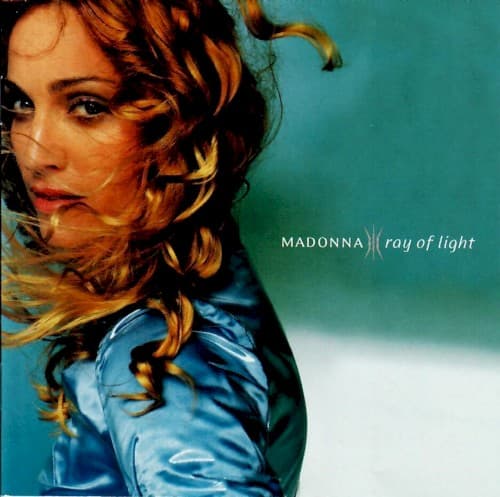
Madonna Ray of Light — The Pop Star Learns Electronica and Stops Performing
Ray of Light is the sound of a pop star trading the stage for the studio and deciding the work matters more than the image. Madonna spent four and a half months on this record with William Orbit, the longest sessions of her career, and you hear it in every layered synthesizer and overdubbed vocal. This is a production album, built from samples and analog gear that broke down constantly, and it required a different kind of performer: one willing to sit still and let the arrangement do the work. The thesis is that Madonna reinvented herself by stepping back, and the evidence is that Ray of Light works best when she sings less and trusts the track more.
The stakes in early 1998 were whether a thirty-nine-year-old pop star could matter in a market dominated by Britney Spears and the Backstreet Boys. Bedtime Stories had softened her image after the Erotica backlash, but ballads and R&B were a retreat, not a move forward. Ray of Light went the other direction: it adopted the electronic and trip hop sounds of Massive Attack and Björk, artists who built albums as sonic statements rather than collections of singles. The gamble was that mainstream pop listeners would follow Madonna into ambient music and six-minute drum-and-bass tracks. The payoff was sixteen million copies sold, four Grammys, and a second act that lasted another decade.
The context is motherhood and mysticism. Madonna gave birth to her daughter Lourdes in 1996 and spent the next year studying Kabbalah, Hinduism and yoga, and the album reflects that shift in literal terms: Sanskrit prayers, references to prophets, songs about her daughter and her dead mother. The spiritual turn is real, but it also gave her something new to sing about after a decade of sex and provocation. The question is whether the music earns the transformation or just repackages it, and the answer changes from track to track.
Orbit's Gear Breaks Down and Builds the Sound
Ray of Light works because William Orbit treated Madonna as one element in the mix instead of the center of it. His background was ambient electronica, and he brought the same approach here: dense analog synthesizers layered with live guitar, glitch effects and arpeggios instead of verse-chorus hooks, arrangements that build slowly and leave space. The title track is the only song that goes full techno, with a four-on-the-floor beat and whistles and bleeps that sound like a rave. Everything else sits in the space between electronica and pop: Drowned World combines orchestral strings with jungle drums, Frozen layers fluid synthesizer lines under a medieval vocal, Skin pairs yearning melodies with hardstep beats.
The production is futuristic in the sense that it imported sounds from underground dance music into a major-label pop album, and in 1998 that was new.
Orbit played nearly all the instruments himself and generated the soundscapes from his Akai sampler, processed through tube compressors. The sessions were delayed constantly because his hardware kept breaking down, and he and Madonna would wait days for repairs before continuing. That stop-start process is audible in the album's texture: these are not live takes but constructed tracks, built from loops and samples and overdubs. The electric guitar on Ray of Light and Candy Perfume Girl has an Oasis-like density, but it is placed in the mix like a sample, not a lead instrument.
The result is a record that sounds both organic and synthetic, old and new at the same time, which was exactly what Madonna said she wanted.
Madonna's vocals benefit from the Evita training. She sings in a higher register on Frozen, incorporates subtle Eastern phrasing, and delivers Mer Girl in a single take that sounds like a confessional. The voice is fuller and more controlled than on Bedtime Stories, and she uses it to add character instead of power. The faintly English accent she adopts on several tracks is less convincing—it sounds borrowed from Orbit's London studio rather than earned—but it fits the ambient mood.
The writing is uneven. The singles are strong: Ray of Light has a rock guitar riff that anchors the techno beat, Frozen builds a hook from four notes and a string line, The Power of Good-Bye is an emotional ballad that meditates on loss without overstatement. The deep cuts are weaker. Candy Perfume Girl pairs a grunge intro with post-modern beeps but never coheres into a song.
Sky Fits Heaven borrows lines from a Gap advertisement and wraps them in spiritual language that sounds like a pamphlet. Nothing Really Matters is an uptempo dance track with techno influences that repeats its title until the phrase loses meaning. These are not filler in the traditional sense—they are fully produced and sequenced with care—but they are ideas stretched to five minutes without enough material to fill the length.
The First Three Tracks Set the Pace, Then the Middle Sags
The record sequences itself as a journey, and the first stretch establishes the route with downtempo trip hop and orchestral textures that build toward spiritual themes. The progression works because each track builds on the last without repeating it, and by the time the title track hits, the album has earned its peak.
The middle section loses that momentum. Four uptempo tracks arrive in a row, all between four and six minutes, and they blur together. The beats are similar, the spiritual themes repeat, and none of them has a hook strong enough to justify the length. The sequence recovers with a Sanskrit prayer sung over a driving dance rhythm that works because it commits fully to the idea, followed by the album's most striking ballad, which should have been the centerpiece but arrives too late to anchor the arc.
The final stretch is the strongest writing on the record. These are slower, more introspective songs about romantic loss and motherhood, and they benefit from the restraint Orbit brings to the production. The closing track in particular is a surreal meditation on the death of Madonna's mother, and the single-take vocal has a rawness that the rest of the album avoids. The album is sixty-six minutes long, and it feels it. Cutting two tracks from the middle would have sharpened the impact and made the final sequence land harder.
The Album That Proved a Pop Star Could Age Into Art
Ray of Light ranks as Madonna's most fully realized album as a production statement, though Like a Prayer remains her stronger collection of songs. This is the record where she stopped performing and started making music that required listening instead of dancing, and that shift mattered more for her career than for pop music itself. Electronica and trip hop were already mainstream by 1998—Björk, Massive Attack and Portishead had been releasing albums for years—but Madonna brought those sounds to audiences who would never buy a Massive Attack record, and that is the album's lasting contribution.
This is for listeners who want to hear a pop star take risks with production and theme, and who can tolerate spiritual lyrics that sometimes read like self-help. Skip it if you prefer the singles-driven Madonna of the eighties or the dance-pop Madonna of the 2000s. The vocal performances are stronger than on any of her previous albums, and the production has aged better than most electronica from the same period, but the writing is inconsistent and the length is a problem.
Start with the title track, Frozen, and Mer Girl to hear the album at its best. If those work, play the first three tracks in sequence to understand the pacing, then decide whether the deep cuts are worth the time. The singles collection is the safer choice for most listeners. For the next step, try Music, the 2000 follow-up that took the electronic production in a more playful direction, or go back to Like a Prayer to hear Madonna's best songwriting. Ray of Light is the album where she became an artist instead of a star, and whether that trade was worth it depends on what you came for.
Track by track
Track Listing
Drowned World / Substitute for Love
StandoutThe opening track sets the tone with downtempo trip hop, jungle drums and orchestral strings layered over electronic beats. The title references a J. G. Ballard science fiction novel, and the lyrics examine romantic disillusionment without overstating it. Orbit kept the original demo mix because later versions lost the spontaneity, and that decision shows in the loose, layered feel. The track works as an album opener because it establishes the electronic-orchestral blend and the introspective mood without demanding too much attention. Released as the third single, it hit number one in Spain and the top ten in Italy and the UK, though the Walter Stern video caused controversy for its paparazzi chase scenes that echoed Princess Diana's death. The song is a strong introduction to the record's aesthetic, even if it does not rank among Madonna's best singles.
Swim
SolidA spiritual meditation with glitch-like textural effects and lyrics about washing away sins and beginning again. The production is restrained, with electronic elements that complement rather than dominate the arrangement. The song continues the downtempo pace of the opener and sets up the acceleration into Ray of Light. It is solid but not essential, a transitional track that does its job without standing out.
Ray of Light
StandoutThe album's only full-throttle techno track and its most successful single. The song pairs a four-on-the-floor beat with a prominent electric guitar riff that anchors the arrangement, and the sound effects—whistles, bleeps—give it a rave energy that nothing else on the record attempts. The production is dense and layered, with synthesizers stacked over live percussion, and the mix balances the electronic and rock elements without letting either dominate. The vocal is powerful, using the extended range Madonna developed during Evita training, and the melody lifts without relying on repetition. Released as the second single, it entered the Billboard Hot 100 at number five, her highest debut ever, and spent four weeks at number one on the Hot Dance Club Play chart. Critics praised its club-oriented yet sonically progressive sound. The track holds up twenty-five years later as both a great pop song and a production showcase, and it is the clearest example of what Madonna and Orbit achieved when they got the balance right.
Candy Perfume Girl
WeakA grunge intro gives way to post-modern beeps and electric guitar flare-ups, but the elements never cohere into a song. The production is busy without being purposeful, and the track feels like a sketch stretched to four and a half minutes. It is the first sign that the album's ambition sometimes outpaces its material.
Skin
SolidAn electronic orchestra backs a yearning vocal in which Madonna sings about romantic desire. The hardstep beats and ambient production create a mood, but the song lacks a strong enough hook to justify its six-minute length. The lyric is simple—repeated questions about recognition and connection—and the arrangement does not develop the idea beyond the first verse.
Nothing Really Matters
WeakAn uptempo dance track with techno influences that repeats its title until the phrase becomes meaningless. The song was inspired by Madonna's daughter Lourdes and explores maternal themes, but the lyric is vague and the hook is weak. The production is competent, with dense synthesizers and a driving beat, but the track feels like filler. It was performed at the 1999 Grammy Awards but was never released as a commercial single outside Japan.
Sky Fits Heaven
WeakA spiritual meditation that borrows lines from a Max Blagg poem used in a 1993 Gap advertisement. The lyric mixes references to prophets with lines about motherhood, and the result reads like new-age self-help rather than a song. The production is solid, with techno beats and layered synthesizers, but the writing is the album's weakest. Released as a promotional single in the US, it peaked at number 41 on the Hot Dance Club Play chart.
Shanti / Ashtangi
StandoutA Sanskrit prayer sung over a driving techno rhythm. Madonna studied with Sanskrit scholar Vagish Shastri to correct her pronunciation before re-recording the affected vocals, and the attention to detail shows. The track works because it commits fully to the idea: the language is unfamiliar to most listeners, but the rhythm and vocal delivery carry it. The song was performed at the 1998 MTV Video Music Awards with Lenny Kravitz on guitar, and it remains one of the album's most distinctive moments. It is proof that Madonna's spiritual turn was more than marketing.
Frozen
StandoutThe album's lead single and its most complete track. The production layers fluid synthesizer arpeggios, strings and ambient textures under a vocal that lacks vibrato and has been compared to medieval music. The hook is built from four notes and a string line, and it lifts without gimmicks. The lyric is about a cold and emotionless man, written after Madonna's breakup with Carlos Leon, and it carries emotional weight without overstatement. The song topped the charts in nine countries and became her first single to debut at number one in the UK. It peaked at number two on the Billboard Hot 100, her sixth number-two hit, a record at the time. Critics called it a masterpiece with a cinematic sound. A Belgian court ruled in 2005 that the opening four-bar theme plagiarized Salvatore Acquaviva's song, banning sales of the single and the album in Belgium until a 2014 ruling overturned the decision. The song holds up as one of Madonna's best singles, a rare case where the ambition and the execution matched.
The Power of Good-Bye
StandoutAn emotional ballad about romantic loss, written after Madonna's breakup with Sean Penn. The production is restrained, with minimal beats and layered vocals, and the melody is strong enough to carry the song without electronic ornamentation. The lyric meditates on longing without becoming sentimental, and the vocal delivery is controlled and nuanced. Released as the fourth single, it reached the top ten throughout Europe and was performed on multiple television programs, including the 1998 MTV Europe Music Awards. It is one of the album's best-written songs and a reminder that Madonna's strength has always been in ballads that balance emotion with restraint.
To Have and Not to Hold
SolidA song about a distant lover with a vibrant surface and restrained arrangement beneath. The production incorporates elements of Latin music, and the vocal is subtle and controlled. The track is solid but not essential, a deep cut that benefits from the album's cohesive production but does not stand out on its own.
Little Star
SolidA song about Madonna's daughter Lourdes with a superficially upbeat arrangement that hides a more introspective lyric. The production is layered and textured, and the vocal is warm and direct. The song was performed on The Oprah Winfrey Show in May 1998, and it works as a quieter moment late in the album's sequence. It is not a standout, but it serves the flow.
Mer Girl
StandoutA surreal meditation on mortality and the death of Madonna's mother, recorded in a single take. The lyric is graphic and unsettling, with lines about smelling burning flesh and rotting bones, and the vocal delivery is raw and unadorned. Orbit recalled that when Madonna stepped out of the vocal booth, everyone in the studio was silent. The production is minimal, with ambient textures and no beats, and the song works because it commits fully to the mood. It is the album's most daring moment and its most personal, a rare case where Madonna's vulnerability is audible instead of performed. The track was included in the Drowned World Tour setlist, and it remains one of her most underrated deep cuts.