Style & Context
Influences
1940s military portraiture, film noir cinematography, Robert Mapplethorpe's sculptural lighting
Location
This cover emerged when pop stars were expected to be apolitical, making Janet's militant styling a deliberate provocation.
Visual Language
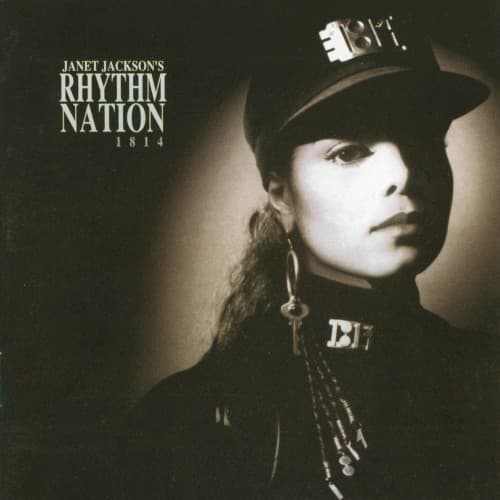
The harsh side lighting and stark contrast create sculptural dimensionality, treating Janet's face as architecture rather than decoration.
Symbols
Military cap with key insignia
The cap transforms Janet from entertainer to commander, the key symbol suggesting she unlocks social change through rhythm.
High collar uniform
The severe neckline erases feminine softness, reclaiming androgynous power dressing for Black women in pop music.
Upward gaze avoiding camera
Janet looks beyond the viewer toward an imagined future, refusing the direct male gaze typical of female pop stars.
Where Sound Meets Image
The austere monochrome matches the album's fusion of hard-edged new jack swing with rock guitars and industrial percussion. The uniform imagery directly supports songs like the title track's call for social unity and 'The Knowledge,' which addresses education inequality. Even the dance tracks like 'Escapade' gain subversive power when delivered by this version of Janet—joy becomes resistance. The militaristic visuals prepared audiences for an album that smuggled serious themes into radio-friendly formats.
This cover established the template for pop stars using fashion as political statement, directly influencing Beyoncé's Formation-era berets and black leather. The androgynous uniform aesthetic became shorthand for female empowerment in 90s R&B, visible in TLC and Aaliyah's tomboy styling. Music videos increasingly adopted this high-contrast, narrative-driven photography over simple glamour shots. The cover proved commercial pop could have visual gravitas, changing expectations for how Black women artists could present themselves.