The scorecard
8.1/10 · Great
- Songwriting25%
- 8.0
- Production25%
- 9.0
- Performance15%
- 7.5
- Cohesion15%
- 8.5
- Originality10%
- 7.5
- Replay value10%
- 7.0
The hooks on "bad guy" and "bury a friend" stick without overreach, though "wish you were gay" fumbles its concept and "8" leans too hard on cuteness.
Finneas O'Connell's bedroom setup yields bass-heavy minimalism that sounds bigger than most major-label pop, with foley details like the Invisalign slurp on "!!!!!!" that double as hooks.
The ASMR whisper works as signature rather than gimmick on "when the party's over" and "listen before i go", but the affected child voice on "8" shows the limits of the approach.
The reverse-order callbacks in "goodbye" and the beat segue from "bury a friend" to "ilomilo" prove the sequencing was deliberate, though "my strange addiction" disrupts the flow with its sitcom samples.
The industrial pop blueprint updates Lorde's Pure Heroine for the streaming era, but the trap drums and whispered vocals were already genre staples by 2019.
"bad guy" and "bury a friend" hold up on repeat, but the album's 42 minutes feel stretched by filler like "8" and "my strange addiction" once the novelty fades.
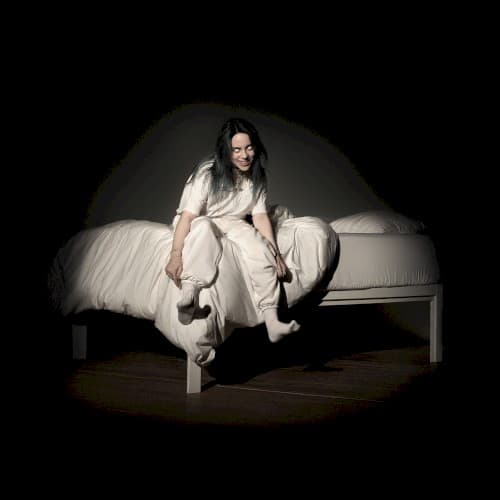
Billie Eilish WHEN WE ALL FALL ASLEEP, WHERE DO WE GO? — The Bedroom That Sold Pop on Whispers
The thesis is in the production credits: Finneas O'Connell's bedroom in Highland Park, a Universal Audio interface, a pair of Yamaha monitors, and Logic Pro X. That setup yielded the biggest pop album of 2019, swept the Grammys, and made Billie Eilish the first artist born this century to win one. The album proved you could build pop stardom on bass-heavy minimalism and ASMR vocals without hiring a team of Swedish writers or booking time at Conway. The sound is spare by design—amplified finger snaps on "bad guy", foley work that turns an Invisalign slurp into a hook, trap drums under whispered threats—and it connected because it sounded like nothing else on pop radio. The question is whether the songs justify the phenomenon or whether the phenomenon was the point.
WHEN WE ALL FALL ASLEEP works as a listening experience: 42 minutes of electropop built around Eilish's soft, close-mic delivery and her brother's knack for making empty space sound intentional. The album draws from industrial music, hip-hop production, and art pop without committing to any of them, which let it slide into playlists next to Ariana Grande and Halsey while sounding more adventurous than either. The streaming numbers backed up the Grammys: 194 million on-demand audio streams in the first week, the third-biggest streaming week ever for an album by a woman at the time. But the Album of the Year win and the best-selling-album-of-2019 status in Canada ask the record to carry more weight than some of these songs can hold. The peaks are clear—"bad guy", "bury a friend", "when the party's over"—but the album also includes "wish you were gay", a song whose concept collapses under light scrutiny, and "8", a ukulele lullaby with vocals pitched to sound like a child that plays more like filler than flex.
Bass, Whispers and the Limits of Bedroom Minimalism
The production here is the argument. Finneas O'Connell strips pop down to bass, minimalist percussion, and whatever sounds were lying around the bedroom—street noise, plane samples, dialogue from The Office. The approach works because the empty space makes Eilish's voice the event. On piano ballads with choral layers, the mix leaves room for every breath and inflection, turning what could be standard heartbreak songs into something that feels uncomfortably close.
The whispered delivery has been compared to ASMR, and the comparison holds: her voice triggers the same intimate unease as someone speaking directly into your ear. It is a specific tool used well on specific songs.
The bass is the other half of the formula. Hooks build around kick drums and amplified finger snaps, letting the low end do the work that a traditional pop chorus would handle with stacked vocals and a key change. Industrial percussion and beats that nod to Kanye West's "Black Skinhead" create minimalist electronica tracks that sound huge despite using almost no instruments. The production is clever in its restraint—adding jazz-inspired loops to replicate the feeling of secondhand smoke, segueing beats directly into electropop for cohesion—but it is also repetitive.
By the back half of the album, the whisper-plus-bass approach starts to feel like a template. Piano ballads with ambient textures are nearly identical in aesthetic, and the lack of dynamic range between them makes the sequencing sag.
The songwriting is stronger on the singles than the deep cuts. The worldwide hit earns its status with a chorus that subverts the typical pop power dynamic—Eilish positioning herself as the threat rather than the pursued—and a structure that withholds the bass drop until the final third, keeping the song unpredictable. Tracks written from the perspective of the monster under the bed use scattered synth melodies and layered vocals to create genuine unease, a horror-movie mood that no other pop song in 2019 attempted. Songs applying trap production to Sherlock fan fiction make it work through sheer commitment to the bit.
But some tracks are clumsy. One central conceit—wishing a guy were gay to explain his lack of interest—plays as tone-deaf even if the intent was self-deprecation. Manipulated vocals that sound like a small child come off as a novelty track rather than a serious exploration of innocence or nostalgia. The Office samples appear for no clear thematic reason, and while Steve Carell and the rest of the cast personally approved the audio, the samples disrupt the album's flow without adding insight.
The album was written and produced entirely by Eilish and her brother, with mixing handled by Rob Kinelski, who had worked on all of Eilish's previous releases. The DIY approach is part of the brand, but it also means the record lacks outside perspective. The sequencing is deliberate—the closer includes reverse-order callbacks to every other track on the album, a clever structural trick—but the album could have used an editor willing to cut weak tracks and tighten the back half. At 14 tracks and 42 minutes, WHEN WE ALL FALL ASLEEP is not bloated by streaming-era standards, but it still includes two or three songs that do not pull their weight.
How the Album Moves and Where It Stalls
The pacing is front-loaded. The album opens with a 14-second intro where Eilish slurps saliva from her Invisalign aligners and laughs with her brother, which is either charming or annoying depending on your tolerance for self-aware quirk. It leads directly into the album's biggest song and one of its best, which sets the tone: playful, bass-heavy, committed to its own strangeness. The next stretch holds the momentum, each track offering a different angle on the whisper-and-bass formula without repeating itself.
The first stretch includes one of the album's poppiest tracks, a punchy piano number that explores climate change through religious imagery, and it works because it is willing to be direct.
The middle sags. The flow derails with a clumsy premise, and one track feels like an interlude stretched to album-track length. The section recovers some energy with bass-heavy production, but the flow remains uneven. The album finds its footing again with two of the strongest tracks before settling into the final stretch of ballads.
The last three songs are deliberately sequenced to form a sentence with their titles, and they function as a suite exploring different versions of farewell. The problem is that they are too similar sonically. All three use the same ambient-piano-plus-whisper approach, and while one lands its suicide narrative with restraint, another covers the same emotional ground with less urgency. The closer works as a conceptual piece, weaving lines from previous tracks into its lyrics, but it arrives after the album has already made its point.
The sequencing shows ambition—beat segues between tracks, reverse callbacks in the finale, thematic grouping of the closing stretch—but the execution is uneven. The album is at its best when it moves quickly between moods and textures, and it stalls when it lingers too long on one idea. A tighter tracklist, cutting one or two weak tracks, would have made the album feel less like a statement and more like a set of great songs.
A Phenomenon That Outgrew the Record
WHEN WE ALL FALL ASLEEP, WHERE DO WE GO? is a very good pop album that became a phenomenon, and the gap between those two things is audible. The peaks—"bad guy", "bury a friend", "when the party's over", "xanny"—are among the best pop songs of 2019, and Finneas O'Connell's production deserves the Producer of the Year Grammy it won. The album proved that minimalist, bass-heavy pop could dominate streaming and radio without sounding like anything else in the top 40, and Eilish's whispered vocals became a signature rather than a gimmick. But the album also includes filler, repetitive sequencing, and at least two songs that collapse under scrutiny. The Album of the Year win and the commercial dominance ask the record to be more cohesive and essential than it actually is.
This is the album for listeners who want pop that sounds different from the Ariana Grande and Halsey records it charted alongside, and it works best for fans willing to forgive the weaker tracks for the sake of the overall mood. It is not the album for anyone expecting every song to justify its place or looking for dynamic range in the production. The whisper-and-bass approach is effective on six or seven tracks and starts to feel like a limitation on the rest. If you are coming to Billie Eilish for the first time, start with "bad guy", "bury a friend", and "when the party's over", then decide whether the rest is worth your time. Skip "8" and "my strange addiction" unless you are committed to hearing the full album.
The record ranks as the debut that launched Eilish into pop stardom, and it holds up better than most streaming-era pop albums from 2019 because the production still sounds distinct. But it is not the all-time classic the Grammys claimed it was, and it will age as a very strong debut that captured a moment rather than as an untouchable statement. The album to hear next depends on what you liked here: if the minimalist production and industrial influences worked for you, try Lorde's Pure Heroine or FKA twigs' LP1. If you are here for Billie Eilish specifically, her second album Happier Than Ever is more consistent and shows growth in the songwriting. WHEN WE ALL FALL ASLEEP proved that bedroom pop could win Album of the Year. It did not prove that every bedroom pop album should.
Track by track
Track Listing
!!!!!!!
SolidA 14-second intro where Eilish slurps saliva from her Invisalign aligners and announces the album before descending into laughter with her brother. It sets the tone for the self-aware quirk that runs through the record, though whether it is charming or annoying depends entirely on your tolerance for that approach.
bad guy
StandoutThe album's biggest hit and one of its best songs, built around a bass line, kick drum, and amplified finger snaps that do the work a traditional pop chorus would handle with stacked vocals. Eilish positions herself as the threat in the power dynamic rather than the pursued, and the song withholds its bass drop until the final third, keeping the structure unpredictable. The production is minimal but huge, and the hook justifies the worldwide success. This is the track that proved bedroom pop could dominate the charts.
xanny
StandoutWritten after Eilish attended a party where her friends kept drinking and throwing up, the song uses a jazz-inspired loop and drum kit to replicate the feeling of secondhand smoke. The whispered vocals work here because the subject matter—being sober at a party full of wasted people—matches the intimate unease of the delivery. The production details, including the sound of someone blowing smoke in Eilish's face, double as hooks.
you should see me in a crown
StandoutTrap-influenced electropop inspired by a Sherlock episode, featuring blaring synths and rapid-fire hi-hats. The song applies trap production to fan fiction and commits fully to the bit, with Eilish delivering threats over industrial percussion. It is one of the album's most aggressive tracks, and the production from Finneas O'Connell makes the bedroom setup sound massive. The track earned a multi-platinum certification and works as a showcase for the album's willingness to push into harsher sounds.
all the good girls go to hell
StandoutOne of the album's poppiest tracks, a punchy piano number that explores climate change and religion through the lens of God and the Devil observing humanity. The production is direct and melody-driven, offering a break from the whisper-and-bass formula without abandoning the album's overall aesthetic. It is one of the few tracks here willing to be straightforward, and it benefits from that clarity.
wish you were gay
WeakA jazzy classic pop song where Eilish wishes a guy were gay to explain his lack of romantic interest in her. The concept is clumsy and tone-deaf even if the intent was self-deprecation, and the song does not earn its place in the tracklist. It disrupts the album's flow without offering insight or a strong enough hook to justify the misstep.
when the party’s over
StandoutA piano ballad with choral influences, written after Finneas O'Connell left his date's house for no clear reason. The whispered delivery here feels justified by the intimacy of the subject matter, and the production leaves space for every breath and inflection, making the performance the event. This is one of the album's most affecting tracks, earning its multi-platinum certification through restraint rather than spectacle. The mix is close enough to feel uncomfortable, which is the point.
8
WeakA ukulele-based lullaby where Eilish's vocals are manipulated to sound like a small child. It plays more like a novelty track than a serious exploration of innocence or nostalgia, and the affected child voice shows the limits of the whisper-and-vocal-manipulation approach. The song is filler.
my strange addiction
SolidA bass-heavy pop song that samples dialogue from The Office, requiring personal approval from Steve Carell, B.J. Novak, John Krasinski, and Mindy Kaling. The samples disrupt the album's flow without adding thematic clarity, and while the production has energy, the track feels like a distraction rather than a contribution to the album's arc.
bury a friend
StandoutMinimalist electronica with industrial percussion, written from the perspective of the monster under the bed. The beat nods to Kanye West's "Black Skinhead", and the scattered synth melodies and layered vocals create genuine unease, a horror-movie mood that no other pop song in 2019 attempted. This is one of the album's best tracks, using the whisper-and-bass formula to maximum effect and proving that Finneas O'Connell's bedroom setup could yield sounds as ambitious as any major-label production. The track earned multi-platinum status and provides the album's title in its lyrics.
ilomilo
StandoutAn electropop cut named after the 2010 video game, with a beat that segues directly from "bury a friend" for cohesion. The production is minimal and melody-driven, and the sequencing choice shows deliberate attention to the album's flow. It is one of the stronger deep cuts, though it does not reach the heights of the singles.
listen before i go
StandoutAn ambient ballad with gentle piano and jazz influences, sung from the perspective of someone about to commit suicide. Faint street noises and sirens bookend the track for atmosphere, and the restrained delivery sells the narrative without overplaying it. This is one of the album's most affecting songs, handling its subject matter with care and specificity. The whispered vocals work because the intimacy matches the vulnerability of the lyrics.
i love you
SolidSimilar in aesthetic to "listen before i go", featuring a sample of an airline attendant and a plane taking off. Finneas O'Connell described it as being about how it sucks to be in love sometimes, and the chorus has drawn comparisons to Leonard Cohen's "Hallelujah". The problem is that it covers the same sonic and emotional ground as the previous track without adding new insight, making the sequencing feel repetitive.
goodbye
SolidThe closer includes a line from each track on the album in reverse order, with clips from those songs layered quietly in reverse as a motif. It is a clever structural trick that ties the album together conceptually, representing rewinding a tape to start over. The execution is deliberate and shows ambition in the sequencing, though the song arrives after the album has already made its point. It works better as a concept than as a standalone track.