The scorecard
8.1/10 · Great
- Songwriting25%
- 8.0
- Production25%
- 9.0
- Performance15%
- 8.5
- Cohesion15%
- 7.0
- Originality10%
- 7.5
- Replay value10%
- 8.0
Five US number-ones from eleven tracks proves the hooks, but filler like "Just Good Friends" and recycled Captain EO material show the strain of narrowing sixty songs to an album
Quincy Jones and Bruce Swedien layer digital synthesizers, Fairlight CMI and rock guitars into a gleaming, high-tech sound that pushed pop production forward without losing warmth
Jackson sheds the high yelps for a more assertive vocal on "Bad" and "Dirty Diana," while the Andraé Crouch choir elevates "Man in the Mirror" into a homily
The album peaks early with the title track and "The Way You Make Me Feel," then scatters between hard rock, adult contemporary and funk without a unifying thread
The aggressive posture and hard rock pivot were new for Jackson, but the sound refines Thriller's blueprint rather than rewriting it
The singles hold up as monuments of late-eighties pop craft; the deeper cuts sag under the weight of excess and the pressure to top an untoppable predecessor
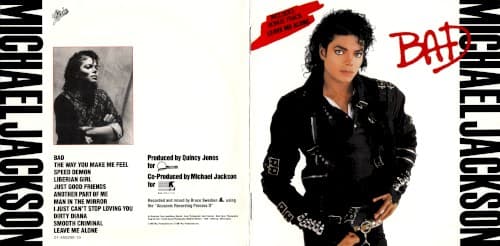
Michael Jackson Bad — When the Follow-Up to History Couldn't Match the Impossible
The challenge was biblical: make a sequel to the best-selling album of all time, in an industry that had spent five years watching Thriller rewrite every commercial rule. Michael Jackson aimed for 100 million copies, recorded sixty songs over two years, and wanted a triple album. Quincy Jones talked him down to eleven tracks, which became Bad in August 1987, and the result is a record caught between confidence and caution. The singles justify the hype—five went to number one in the US, a record—but the album never decides whether it wants to harden Jackson's image with rock guitars and street slang or repeat the crossover formula that made Thriller inescapable. It does both, and the seams show.
Bad sold 2.25 million copies in its first week and topped the US chart for six weeks, but American media called it a disappointment because it moved eleven million fewer copies than Thriller had by the same point. The shortfall was blamed on Jackson's controversial appearance: lighter skin from vitiligo, plastic surgery, and an edgier wardrobe that read as calculated rather than natural. The music itself is a technical marvel, with digital synthesizers and hard rock flourishes that pushed pop production into the digital age, but the sequencing scatters the album's energy across ballads, funk, gospel and rock without a unifying argument. The title track and "Smooth Criminal" deliver on the tougher persona; "Man in the Mirror" and "I Just Can't Stop Loving You" aim for Thriller's adult-contemporary reach; "Just Good Friends" and "Liberian Girl" pad the runtime. What holds it together is Jones and Bruce Swedien's production, which makes every track sound expensive, and Jackson's vocal command, which had matured past the high yelps of his earlier work into a more grounded, assertive delivery. Bad is a great singles collection and a good album, but it never escapes the shadow it was designed to outrun.
The High-Tech Pivot: Digital Synths, Hard Rock, and the Sound of 1987
Jackson wanted a harder sound, and Jones gave him the tools: FM synthesis, the Fairlight CMI, the Synclavier, and a roster of session musicians who could layer rock guitars over dance-pop beats without losing the groove. The result is a gleaming, aggressive record that sounds like 1987 in the best and worst ways—immaculate studiocraft that sometimes sacrifices warmth for precision. The title track opens with a drum crack from John Robinson and a bassline that borrows the blues progression of "Hit the Road Jack," but the real innovation is in the layered synthesizers and the way Jackson's vocal toggles between bravado and vulnerability. The chorus hook is simple and bulletproof, and the bridge builds tension with a gang vocal that makes the boast feel earned. It is Jackson at his most assertive, and the production—crisp, digital, aggressive—sells the persona shift.
"The Way You Make Me Feel" recycles the Motown shuffle and Jerry Hey's horn charts from Thriller, but the synthesizer stabs and the finger-snap rhythm keep it from feeling like a retread. The verses coast on Jackson's phrasing, and the chorus delivers the kind of melodic lift that justifies the single release. "Dirty Diana" is the album's hardest pivot, with Steve Stevens' guitar solo and a lyric about groupies that aims for "Billie Jean" darkness but lands somewhere between intrigue and discomfort. The production is dense—multiple synthesizer layers, live drums, and a mix that foregrounds the guitar without burying the vocal—but the track never resolves its tonal ambiguity. It works as a reveal for Jackson's range, less so as a song.
The ballads expose the album's weaknesses. "I Just Can't Stop Loving You" is competent adult contemporary with finger snaps and timpani, and Siedah Garrett's duet vocal adds warmth, but the melody is forgettable and the bridge goes nowhere. "Man in the Mirror," written by Garrett and Glen Ballard, is the exception: a gospel-pop anthem with a chord progression that builds to the Andraé Crouch choir, which transforms the homily into catharsis. The production is restrained until the final minute, when the choir and the synthesizer swell together, and Jackson's ad-libs sell the conversion narrative. It is the album's emotional peak, and it works because the arrangement earns the scale.
Elsewhere, the production compensates for weaker material. "Smooth Criminal" layers an eerie heartbeat, live drums, and synthesizer arpeggios into a noir thriller, with a bassline and a rhythm that make the crime-scene lyric feel filmic. The "Annie, are you OK?" hook—borrowed from CPR training—is absurd on paper but indelible in execution, and the bridge shifts from minor to major without losing momentum. "Speed Demon" and "Another Part of Me" are serviceable funk tracks with synthesizer flourishes and tight rhythm sections, but neither offers a hook strong enough to justify the runtime.
"Just Good Friends," a duet with Stevie Wonder, is filler by Jones' own admission—a mid-tempo R&B track with a melody that dissolves on contact. "Liberian Girl" recycles a demo from the Victory sessions, adds a Swahili chant, and coasts on atmosphere rather than structure. The sequencing fails these tracks by placing them in the album's midsection, where the momentum stalls.
The Pacing Problem: How Bad Peaks Early and Sags in the Middle
Bad is front-loaded by design: the opening stretch establishes the aggressive, uptempo persona in the first twelve minutes, and the album never recovers that energy. The middle section drops the tempo and the stakes, and while the gospel peak provides a lift, the album loses its thread. By the time the harder tracks arrive late in the sequence, the pacing has already undercut the tougher image the opener promised. A better track order would have buried the filler and built toward a climax, but the final stretch feels like an afterthought, three strong efforts in a row that deserved a stronger setup.
The eleven-track runtime is lean compared to the bloat of later Jackson albums, but the decision to narrow sixty songs to a single disc left the album without a unifying concept. Thriller worked as a sequence because every track served the crossover thesis; Bad works as a collection of singles, some of which happen to be on the same record. The bonus track on the CD release is a paranoid funk effort that addresses tabloid rumors with a winking edge, and it closes the album on a note of self-awareness that the rest of the record never quite earns. The pacing problem is not fatal—most listeners in 1987 experienced Bad as a string of singles, not as an album—but it keeps the record from ranking with Jackson's best. The peaks are high enough to justify the purchase; the valleys are deep enough to skip.
Where Bad Ranks: A Singles Triumph, an Album Compromise
Bad is Jackson's second-best album, which in 1987 felt like failure and in hindsight looks like a reasonable outcome when the standard is Thriller. The five US number-ones—"I Just Can't Stop Loving You," "Bad," "The Way You Make Me Feel," "Man in the Mirror," "Dirty Diana"—are monuments of late-eighties pop craft, with hooks and production that set the template for the next decade of dance-pop and R&B. The deeper cuts are mixed: "Smooth Criminal" and "Leave Me Alone" are essential, "Speed Demon" and "Another Part of Me" are solid, and "Just Good Friends" and "Liberian Girl" are filler that a tighter edit would have cut. The production is flawless, the vocal performances are among Jackson's most assured, and the attempt to toughen his image—though undercut by tabloid scrutiny and an inconsistent tracklist—moved him away from the child-star persona that had defined his early solo work. It is a great singles collection and a good album, which is not the same thing as a great album.
For new listeners, start with "Bad," "Smooth Criminal," and "Man in the Mirror," which demonstrate the range and the craft. Skip "Just Good Friends" unless you are a completist. The album works best as a playlist: the five singles, plus "Smooth Criminal" and "Leave Me Alone," make a case for Jackson's dominance in 1987 and 1988. Fans who want the full arc should hear Thriller first, then Off the Wall, then Bad—this is where the vision plateaus.
The album sold 35 million copies worldwide, topped charts in twenty-four countries, and launched a tour that grossed $125 million, but it never shook the perception that it fell short. That perception is both unfair and accurate: Bad is a triumph by any standard except the one Jackson set five years earlier, and the follow-up to the Bible was never going to be scripture. It is a record that proves Jackson's songwriting had matured, his production team had mastered digital technology, and his vocal command had deepened, but it also proves that no amount of craft can escape the gravity of impossible expectations. Start here if you want the singles; start with Thriller if you want the album.
Track by track
Track Listing
Bad
StandoutThe title track opens with John Robinson's drum crack and a bassline that borrows the blues progression of "Hit the Road Jack," but the real innovation is in the layered synthesizers and the way Jackson toggles between bravado and vulnerability. The chorus hook is simple and bulletproof, and the gang vocal in the bridge sells the street-slang persona. Christopher Currell's Synclavier work and Jimmy Smith's Hammond organ add texture without clutter, and the production—crisp, digital, aggressive—makes the boast feel earned. The lyric, inspired by a newspaper story about a boy killed by jealous friends, aims for social commentary but lands as pure swagger. The track was conceived as a duet with Prince, who declined over the opening line, and the solo version benefits from the absence: Jackson owns the attitude without sharing the spotlight. It is the album's thesis statement, and the strongest argument for the image reinvention.
The Way You Make Me Feel
StandoutA Motown shuffle with Jerry Hey's horn charts and a finger-snap rhythm that coasts on Jackson's phrasing. The verses are smooth, the chorus delivers a melodic lift, and the production—synthesizer stabs, live horns, Paulinho da Costa's percussion—keeps it from feeling like a Thriller retread. The bridge is forgettable, and the outro ad-libs run long, but the hook is strong enough to justify the single release. It is a solid dance-pop track that works better on the radio than in the album sequence, where it arrives too soon after the title track's aggression.
Speed Demon
SolidA serviceable funk track with a racing-car intro and synthesizer flourishes from Currell's Synclavier. The rhythm section is tight, with multiple percussionists and drum programming from Douglas Getschal, but the melody is thin and the hook is a chant rather than a chorus. Jackson wrote the song after receiving a speeding ticket, and the lyric's playful tone never develops into a narrative. The production compensates with layered textures and a mix that foregrounds the rhythm, but the track feels like a demo that was finished rather than refined.
Liberian Girl
WeakA recycled demo from the Victory sessions, rerecorded with a Swahili chant from Letta Mbulu and synthesizer work from Michael Boddicker, David Paich, and Steve Porcaro. The atmosphere is lush, with layered keyboards and a mid-tempo groove, but the melody dissolves on contact and the structure is static. Jackson described writing the song while playing pinball, and the casual origin shows: it is a vibe track without a hook. The chant adds texture but not meaning, and the sequencing places it in the album's midsection, where the momentum stalls.
Just Good Friends
WeakFiller by Quincy Jones' own admission. A duet with Stevie Wonder, written by Terry Britten and Graham Lyle, with a mid-tempo R&B groove that goes nowhere. Wonder plays a synthesizer solo, and the production is competent, but the melody is forgettable and the chemistry between Jackson and Wonder never materializes. The track was recorded in a single day in June 1987, and the rush shows. It is the weakest song on the album and the most obvious candidate for a tighter edit.
Another Part of Me
SolidOriginally developed for Captain EO in 1984 and revisited for the album in 1986 and 1987. The production is dense, with synthesizer layers and a funk rhythm section, but the hook is a chant rather than a melody. The lyric about planetary alignment and unity ties to the Harmonic Convergence phenomenon of 1987, and the New Age vibe feels dated even by the standards of the late eighties. The track works as a showcase for the production team's technical skill—multiple synthesizers, live drums, tight arrangement—but it lacks the emotional core that makes the best Jackson songs stick.
Man in the Mirror
StandoutA gospel-pop anthem written by Siedah Garrett and Glen Ballard, with a chord progression that builds to the Andraé Crouch choir and a homily about personal change that transcends its earnestness. The production is restrained until the final minute, when the choir and the synthesizer swell together, and Jackson's ad-libs sell the conversion narrative. The bridge extends the melody without losing momentum, and the arrangement earns the scale. It is the album's emotional peak and the strongest evidence that Jackson could inhabit a song he did not write. The lyric is straightforward—"If you wanna make the world a better place, take a look at yourself and then make a change"—but the choir and the vocal performance transform the platitude into catharsis.
I Just Can’t Stop Loving You
SolidCompetent adult contemporary with finger snaps, timpani, and a duet vocal from Siedah Garrett that adds warmth. The melody is forgettable, the bridge goes nowhere, and the production—though polished—cannot compensate for the weak songwriting. Jackson wanted Whitney Houston or Barbra Streisand for the duet; Houston's label thought it was too risky, and Streisand declined. Garrett is a capable substitute, but the song itself is filler dressed up with expensive production. It was the album's first single, and its success—number one in the US—says more about Jackson's commercial momentum than the track's merits.
Dirty Diana
SolidThe album's hardest rock pivot, with Steve Stevens' guitar solo and a lyric about groupies that aims for "Billie Jean" darkness but lands somewhere between intrigue and discomfort. The production is dense—multiple synthesizer layers, live drums from John Robinson, and a mix that foregrounds the guitar without burying the vocal—but the track never resolves its tonal ambiguity. The verses describe a sexual predator, the chorus shifts to Jackson's perspective, and the bridge offers a guitar solo that overshadows the melody. It works as a showcase for Jackson's range and the production team's ability to incorporate hard rock into a pop framework, but the song itself is more interesting than enjoyable. The outro ad-libs—"come on," "hey baby wontcha"—run long, and the fade feels abrupt after the buildup.
Smooth Criminal
StandoutA noir thriller with an eerie heartbeat, live drums from John Robinson and Bill Bottrell, and synthesizer arpeggios that set the tone for the crime-scene lyric. The "Annie, are you OK?" hook—borrowed from CPR training—is absurd on paper but indelible in execution, and the bridge shifts from minor to major without losing momentum. The production layers texture without clutter: synthesizers from John Barnes and Michael Boddicker, bass and guitar from Nathan East and David Williams, and a mix from Bruce Swedien that makes every element audible. The structure is verse-chorus-verse-bridge-chorus, with an instrumental outro that fades on the heartbeat. It is one of Jackson's most captivating songs, a technical marvel that matches the craft of "Billie Jean" and surpasses it in cinematic scope.
Leave Me Alone
StandoutA bonus track on the CD release, recorded in June 1987 as a response to tabloid rumors. Disguised as a song about moving on from a romantic lover, it reads as a paranoid anthem about fame, and the music video for Moonwalker made the subtext text by exaggerating the tabloid stories. The production is tight funk with synthesizer programming from Casey Young, drum programming from Larry Williams, and guitar from Paul Jackson Jr. The hook is a chant rather than a melody, and the structure is static, but the attitude is self-aware and the sequencing—closing the album—makes it feel like a postscript. It is not essential, but it is more interesting than "Just Good Friends" or "Liberian Girl," and it should have been on the standard tracklist.