The scorecard
8.9/10 · Essential
- Songwriting25%
- 8.5
- Production25%
- 9.5
- Performance15%
- 9.0
- Cohesion15%
- 9.0
- Originality10%
- 8.0
- Replay value10%
- 8.5
"Cuff It", "Break My Soul", and "Virgo's Groove" build hooks from chorus repetition that compounds rather than wears thin, while "Plastic Off the Sofa" proves she can write a verse that earns its intimacy without spectacle.
The transitions alone—"Energy" bleeding into "Break My Soul" via Big Freedia's "Explode", "I'm That Girl" morphing into "Cozy" without a seam—are masterclasses in sequencing, and the mix keeps sixteen tracks of house, disco, and Afrobeats from blurring together.
She raps like a ballroom emcee on "Pure", belts like a diva house queen on "Break My Soul", and sings through the extended grooves of "Virgo's Groove" without once sounding like she is chasing the beat instead of riding it.
Arranged like a DJ set with beatmatched transitions, the album flows from the murky bass of "I'm That Girl" to the Donna Summer homage of "Summer Renaissance" without a single jarring cut, though the back half sags slightly between "Thique" and "America Has a Problem".
It does not reinvent house or disco so much as recontextualize them through ballroom language, Afrobeats, and New Orleans bounce, which is enough to make "Alien Superstar" and "Church Girl" sound like nothing else in the 2022 pop catalog.
Two years out, "Cuff It" remains her longest-charting Hot 100 entry for a reason, and the album's club framework means the grooves reward repeated listens more than narrative arcs or lyric sheets.
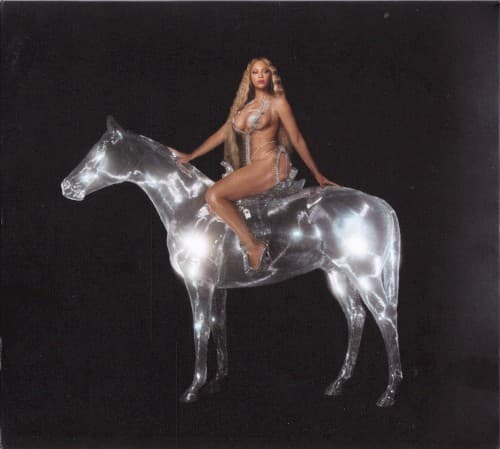
Beyoncé RENAISSANCE—The Club as Cathedral and Thesis
RENAISSANCE is an argument that pop's most technically accomplished vocalist can command a dance floor for an hour without relenting, and that the club—specifically the Black and queer clubs where house, disco, and ballroom were forged—deserves the same conceptual ambition Beyoncé brought to Lemonade's narrative of betrayal and Black Is King's Afrofuturist spectacle. The album opens with "I'm That Girl", a bass-heavy flex that distorts its central refrain into a mantra, then spends the next sixty-two minutes proving the claim across sixteen tracks of post-1970s Black dance music: Chicago house, Detroit techno, New Orleans bounce, disco that nods to Donna Summer, and ballroom that samples Kevin Aviance. It is sequenced like a DJ set, with beatmatched transitions that collapse the space between songs, and it sounds like a record made by someone who studied the mechanics of the dance floor and then bent a pop album's resources—guest verses from Grace Jones and Tems, production from Honey Dijon and Skrillex, a three-year recording process—toward replicating its flow. The thesis is that Beyoncé, who built her catalog on narrative and visual spectacle, can make a club record that works as a club record: no skits, no interludes, no ballads that stop the momentum, just a sustained argument that dancing is liberation and the dance floor is a space of refuge. The stakes are whether she can inhabit that space convincingly, and whether a pop album in 2022 can honor the pioneers of house and disco without flattening them into samples and vibes.
The Architecture of the Floor
The production is immaculate in the way that only a Beyoncé album can be immaculate: every snare crack, synth stab, and vocal layer sounds placed rather than programmed. The transitions—
The Set, Peak to Cool-Down
The pacing is classic DJ logic: build, peak, sustain, release. The opening stretch establishes the club as a space of self-assertion, moving through Chicago house and ballroom language before hitting its first peak with retro-disco that feels like the moment the floor locks in. The next section forms a two-song suite that represents the album's commercial and thematic center: a minimal, hypnotic bridge sets up the diva house anthem that became her first solo number-one without a featured artist since "Single Ladies". The sequence through this middle stretch is the album's strongest, moving from the euphoria of quitting your job to the bodily autonomy of rejecting religious constraint to the quiet intimacy of a relationship that survives the noise. The back half sags slightly—two tracks in the middle are solid but not essential, and the stretch from track twelve to track fourteen feels longer than it is. The closing run resets the energy with a split ballroom-disco track before the finale interpolates Donna Summer in a way that feels like the sun coming up. The album is too long by two or three tracks, but the sequencing is strong enough that the length feels like a choice rather than a miscalculation: this is a record that wants to replicate the experience of staying on the floor until closing.
The Dancefloor Thesis, Proven
RENAISSANCE ranks as Beyoncé's most cohesive album since her self-titled 2013 release, and the most ambitious dance-pop record by a major artist since Lady Gaga's Chromatica, which it surpasses in both execution and conviction. It is not her most important album—that remains Lemonade, which redefined what a pop album could say about Black womanhood and heartbreak—but it is her most consistent, and the one that works best as a pure listening experience. The album is for listeners who want to hear Beyoncé command a genre she has never fully inhabited, and for fans of house, disco, and ballroom who want to hear those genres treated with the production resources and conceptual seriousness that pop usually reserves for rock or R&B. It is not for listeners who want lyrical storytelling or the narrative ambition of her previous albums; the lyrics here are functional, built for repetition and dance rather than close reading.
Start with "Cuff It", "Break My Soul", and "Virgo's Groove" to understand what the album does best, then play it front to back to hear how the sequencing works. Skip it if you need ballads or if the idea of a sixty-two-minute dance record sounds exhausting rather than liberating. For next steps, hear Donna Summer's I Remember Yesterday for the disco blueprint, or Honey Dijon's Black Girl Magic for a contemporary take on house from one of RENAISSANCE's key collaborators. Two years out, the album has aged better than most 2022 releases: "Cuff It" remains her longest-charting Hot 100 entry, the Renaissance World Tour grossed over five hundred seventy-nine million dollars, and the album's celebration of Black queer club culture feels more urgent rather than less. It is a thesis album in the best sense—an argument made with evidence, defended across sixteen tracks, and proven by the fact that it still works on the dance floor.
Track by track
Track Listing
I’M THAT GIRL
StandoutA statement of intent built on murky bass, distorted synth stabs, and a repeated refrain that sounds like a mantra run through a compressor. The production, handled by Beyoncé alongside Kelman Duran and Mike Dean, is atmospheric in a way that most pop opening tracks are not—it wants you to feel the space of the club before it gives you the beat. The rap-sung delivery and the Tommy Wright III interpolation establish the album's confidence-as-thesis framework, and the transition into "Cozy" is seamless, with the bass dropping out just as the Chicago house kick comes in. It is an effective opener that sets the tone without overstaying its welcome, though the distortion occasionally obscures the vocal in a way that feels more like an effect than a choice.
COZY
StandoutA Chicago house track with a deep house bassline and lyrics about self-love that double as trans empowerment, produced by Honey Dijon, one of the album's key collaborators. The production is clean and spacious, with the kick and bass doing most of the work, and the vocal sits higher in the mix than on the opener, which makes the hook—"comfortable in my skin"—land with more clarity. It is one of the album's most straightforward tracks, both in structure and message, and it works because it does not overreach. The transition into "Alien Superstar" is handled via a synth riser that feels like the floor shifting gears.
ALIEN SUPERSTAR
StandoutA ballroom homage that interpolates Right Said Fred's "I'm Too Sexy" and samples Barbara Ann Teer, with staccato synths and a vocal delivery that mimics the cadence of a ballroom emcee. The production is sharp and percussive, with the synths firing like rim shots, and the lyrics lean into Afrofuturist imagery and self-celebration. It is one of the album's most stylistically specific tracks, and it succeeds as homage, though the Right Said Fred sample is more clever than transformative. The outro, which features Teer's autobiographical recording, adds a layer of context that the track itself does not quite earn, but the energy is undeniable and the transition into "Cuff It" is the album's smoothest.
CUFF IT
StandoutThe album's first undeniable peak, a retro-disco track that interpolates Teena Marie's "Ooo La La La" and builds its hook from a chorus that repeats until it feels like muscle memory. The production, handled by Nova Wav and The-Dream, is warm and analog-sounding, with live bass and handclaps that give the track a physicality most digital disco records lack. The lyrics are about physical attraction and uninhibited expression on the dance floor, and the performance is loose and confident in a way that makes the song feel lived-in rather than constructed. It became her longest-charting Hot 100 entry for a reason—it is the most immediately replayable track on the album, and the one that works best outside the album's sequenced context. The bridge, where the bass drops out and the vocal floats over just the hi-hat, is the album's single best production moment.
ENERGY
SolidA minimal, onomatopoeic bridge between "Cuff It" and "Break My Soul", featuring Beam and incorporating Afrobeats and funk elements. At under two minutes it is more interlude than full track, but it serves a structural purpose: the Teena Marie interpolation carried over from "Cuff It" keeps the groove intact, and the closing seconds introduce a sample of Big Freedia's "Explode" that acts as both outro and intro for "Break My Soul". The production is sparse—just bass, a few synth hits, and the vocal—and the brevity is a strength. It is functional and effective, and it earns its place in the sequence.
BREAK MY SOUL
StandoutThe lead single and the album's commercial centerpiece, a diva house track built on samples of Big Freedia's "Explode" and Robin S.'s "Show Me Love". The production is immediately recognizable as house music—four-on-the-floor kick, piano stabs, the Freedia sample chopped and looped as a hook—and the lyrics are about liberation from a demanding job and the pressures of the pandemic. It is the most lyrically direct track on the album, with lines like "Now, I just fell in love / And I just quit my job" that The-Dream wrote from his trailer during the recording process, and the performance is big and declarative, with the vocal mixed loud enough to cut through the sample-heavy production. It peaked at number one on the Hot 100 and became her eighth chart-topper as a solo artist, and it works both as a pop single and as the album's thematic thesis: the dance floor as escape, the club as liberation. The transition out, into "Church Girl", is handled via a tempo shift that feels like the set changing gears.
CHURCH GIRL
StandoutA New Orleans bounce track that samples the Clark Sisters' "Center of Thy Will" and the Showboys' "Drag Rap", with lyrics about bodily autonomy and rejecting the religious and societal expectations placed on Black women. The production is percussive and propulsive, with the bounce rhythm—quick, syncopated drums—pushing the track forward, and the gospel sample adds a layer of irony that the lyrics make explicit. It is one of the album's most thematically sharp tracks, and the production, handled by No I.D. and The-Dream, does not soften the edge. The vocal is aggressive and confident, and the transition into "Plastic Off the Sofa" is one of the album's most dramatic shifts, moving from the frenetic energy of bounce to the subdued intimacy of neo-soul.
PLASTIC OFF THE SOFA
StandoutThe album's lone ballad, a neo-soul track with alternative R&B influences that strips the production back to bass, keys, and vocal. Produced by Syd, it is the quietest and most vulnerable moment on the album, with lyrics about navigating everyday life despite global prominence. The performance is understated, with the vocal sitting low in the mix and the delivery more conversational than declarative. It is a necessary reset after the intensity of "Church Girl", and it proves that the album can slow down without losing its focus. The transition into "Virgo's Groove" is handled via a slow build, with the bass gradually thickening and the tempo creeping up until the groove locks in.
VIRGO’S GROOVE
StandoutThe album's longest track at six minutes, a disco-funk love song that forgoes conventional pop structure in favor of extended grooves, ad-libs, and call-and-response sections. The production, handled by Kali and The-Dream, is built on slap bass, airy synths, and layered vocal harmonies that compound as the track progresses. It is the album's most indulgent moment, and the length is earned—the groove is hypnotic enough that the six minutes feel shorter than the four minutes of some of the album's weaker tracks. The performance is loose and improvisational, with Beyoncé singing through the groove rather than over it, and the track works as both a showcase for her vocal control and as a functional dance track. It was released as the third single in Europe, and it is one of the album's best arguments for its own sequencing: heard in isolation it is a great song, but heard in context it is the moment where the album fully commits to the dance floor as a space where time expands.
MOVE
StandoutAn Afrobeats and house hybrid featuring guest vocals from Grace Jones and Tems. Jones, who criticized Beyoncé in her memoir, contributes spoken-word vocals that add a layer of gravitas to the track, and Tems sings the hook with a breathy delivery that contrasts with Beyoncé's more assertive performance. The production, handled by P2J and GuiltyBeatz, is polyrhythmic and layered, with the Afrobeats drums sitting underneath a house-tempo kick. It is one of the album's most sonically dense tracks, and the guest features—Jones in particular—feel like more than cameos. The transition into "Heated" is seamless, with the Afrobeats rhythm carrying over.
HEATED
StandoutAn Afrobeats and dancehall track with elements of ballroom language and lyrics that pay tribute to "Uncle" Johnny, Beyoncé's gay cousin who helped raise her until his death during the AIDS epidemic. The production is rapid-fire and percussive, with the dancehall rhythm giving the track a jittery energy, and the vocal is braggadocious and playful. It is one of the album's most explicitly celebratory tracks, and the tribute to Johnny—who is cited as a key inspiration for the album's focus on Black queer club culture—adds emotional weight without slowing the momentum. The transition into "Thique" is abrupt, with the tempo dropping and the production shifting from Afrobeats to trap, which is one of the album's few jarring cuts.
THIQUE
SolidA dubstep-oriented hip-hop track with trap drums and a muted techno bassline, thematically centered on body positivity. Produced by Hit-Boy, who revealed the song was first made in 2014, it sounds like a relic of mid-2010s EDM-pop, and it does not quite fit the album's otherwise cohesive aesthetic. The vocal is aggressive and the production is dense, but the track feels more like a leftover than a necessary inclusion. It is serviceable filler, and the transition into "All Up in Your Mind" is one of the album's weaker moments.
ALL UP IN YOUR MIND
SolidA synth-pop track with a woozy bassline and laser-like synths, produced by BloodPop and A. G. Cook. The production nods to the sound of Lady Gaga's Chromatica, with the synths firing in arpeggiated patterns and the bass wobbling underneath, and the vocal is more subdued than on the surrounding tracks. It is a solid mid-album track that does not reach for a peak, and it works as a transition between the trap energy of "Thique" and the electro-funk of "America Has a Problem". It is pleasant but not essential.
AMERICA HAS A PROBLEM
SolidAn electro-funk and hip-hop track built on stark synth chords and rapid, percussive beats, with lyrics that use addiction as a metaphor for desirability. It samples Kilo Ali's "Cocaine", and the production is sharp and minimal, with the synths doing most of the work. The metaphor is clever but the execution is more functional than compelling, and the track feels like a sketch that was expanded into a full song without quite earning the length. It was later remixed with Kendrick Lamar as the album's fourth single, but the original album version is one of the weaker entries in the back half.
PURE/HONEY
StandoutA two-part track that splits into "Pure", a ballroom track that samples MikeQ and Kevin Aviance, and "Honey", a disco track that samples Moi Renée. "Pure" features sharp synth-bass and a vocal delivery that mimics a ballroom emcee, with Beyoncé rapping in the same staccato cadence that defines "Alien Superstar". "Honey" shifts into a funk-influenced brass production with a warmer, more melodic vocal. The split structure is effective—"Pure" resets the energy after the sag of the previous three tracks, and "Honey" builds toward the album's closing statement. It is one of the album's most compositionally ambitious tracks, and both halves earn their place in the sequence.
SUMMER RENAISSANCE
StandoutThe album's closing track, a disco and house song driven by synthesizers that interpolates Donna Summer's "I Feel Love" and Larry Heard's "Mystery of Love". The production is lush and expansive, with the synths building in layers until the track feels like it is lifting off the floor, and the vocal is mixed to sound like it is echoing across a club at closing time. The lyrics are about a connection formed over the course of the night, and the performance is both triumphant and exhausted, which is the right tone for a closer. The Donna Summer interpolation is the album's most direct homage, and it works because the production does not just sample the original—it rebuilds it from the ground up, with the arpeggiated synth line from "I Feel Love" serving as the track's foundation. It is a perfect closer, and the final seconds fade out without a hard stop, which feels like the album walking out of the club and into the morning.