The scorecard
8.2/10 · Great
- Songwriting25%
- 9.0
- Production25%
- 8.5
- Performance15%
- 8.0
- Cohesion15%
- 7.0
- Originality10%
- 7.5
- Replay value10%
- 8.5
Taupin writes 17 songs without one generic phrase: the Monroe portrait, the pub brawl, the movie metaphors, the Oz farewell land as specific images on first hearing.
Dudgeon builds clean spaces for the 11-minute suite, the glam stomp and the piano ballads, with Del Newman's strings lifting where needed and never smothering.
John shifts from the sustained control of Candle in the Wind to the snarl of Saturday Night's Alright without straining; backing vocals on the rockers add heft without crowding.
The first disc flows from the suite through the ballads to the Jamaican joke; the second disc sags through three mid-tempo character sketches before the closer rescues it.
The suite structure and the cinematic lyric conceits were new for John in 1973; the glam crunch and piano-led storytelling refined what Honky Château started.
The singles and the suite have held rotation for five decades; even the deep cuts reward repeat listens once you accept the uneven pacing of the second half.
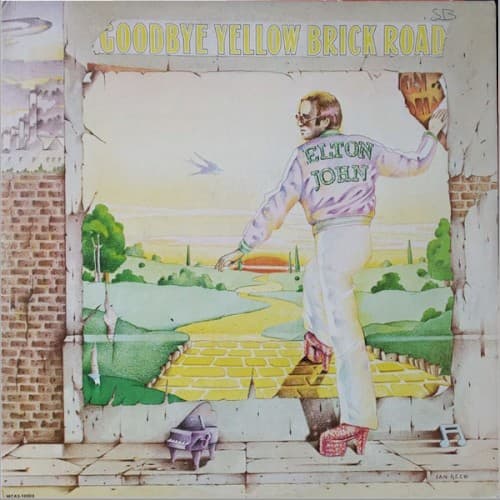
Elton John Goodbye Yellow Brick Road — When the Double Album Earned Its Length
Goodbye Yellow Brick Road is Elton John's argument that he could fill four sides without filler, and for three of those sides he wins. Recorded in two weeks at the Château d'Hérouville after a failed Jamaica session, the album became a double LP because John and Bernie Taupin composed 22 tracks and the locale inspired them to keep going. The result is 76 minutes that include an 11-minute suite, a number-one single built on a synthetic handclap, a Marilyn Monroe portrait that became a global funeral standard, and a glam brawler inspired by a Market Rasen pub.
The thesis is in the sequencing: John could move from sustained drama to a two-minute campfire finish without losing the thread, because Taupin's lyrics framed the whole album as a filmic look backward at a childhood and a culture left behind. The album topped charts in four countries, sold over 20 million copies, and was inducted into the Grammy Hall of Fame in 2003. It remains John's best-selling studio album and the clearest case for his range at the moment he had the confidence to use all of it. The question is whether 17 tracks justified the double-album gamble or whether the format let a few songs through that a single LP would have cut.
Piano, Glam Crunch and Strings That Know When to Step Back
The album works because producer Gus Dudgeon and the four-piece band built clean, specific spaces for each song without trying to unify them under one production stamp. Funeral for a Friend opens with synthesizer atmospherics from David Hentschel before the band enters for Love Lies Bleeding, a piano-led rocker that shifts tempo twice without stumbling. Dudgeon gives the suite room to breathe: the drums are dry, the guitars are clear in the mix, and the transitions between sections happen on the performance rather than on studio effects. Bennie and the Jets runs the opposite strategy, leaning into the synthetic handclap and the Farfisa organ to make the song sound like it was recorded in an arena even though it was tracked at the Château. The gimmick works because John's vocal stays loose and the arrangement leaves space around the chorus.
Del Newman's orchestral arrangements appear on six tracks and lift without smothering. The strings on the title track enter after the first chorus and double the melody instead of adding a separate counter-line; the strings on I've Seen That Movie Too wait until the bridge and then pull back for the final verse. Newman knows when to stay out: Saturday Night's Alright for Fighting is all guitar, bass, drums and piano, with Davey Johnstone's slide guitar carrying the aggression that the lyric demands. The arrangement on Candle in the Wind is sparse piano, acoustic guitar and strings, recorded in a single take according to Dudgeon's liner notes, and the restraint is what makes the song work. John's vocal is controlled and the strings enter only to support the chorus, never to sweeten the sentiment.
The band plays on all but one track, with Johnstone, Dee Murray and Nigel Olsson handling guitars, bass and drums across the rockers and the ballads. The weaknesses come from the songs Taupin wrote as character sketches without strong melodies to carry them. Sweet Painted Lady, Dirty Little Girl and Roy Rogers are mid-tempo story songs with verses that meander and choruses that never lift. John's melodies on these three are functional but forgettable, and the arrangements do not add enough to justify the five minutes each track takes. The album would have been tighter as a single LP with those three cut and the rest sequenced for flow rather than for vinyl side breaks.
Three Strong Sides and One That Sags
The album peaks on the first disc and the first half of the second, then loses momentum through the character sketches before the closer rescues it. The first side runs from the 11-minute suite through the two biggest singles to the title track, a sequence that establishes the range and never dips. The second side moves from a solo piano meditation that works as a breather, through the re-recorded opener and the Jamaican joke track, which is filler but short enough not to drag, to a five-minute ballad with a strong filmic lyric. The third side opens with two solid efforts, then stumbles through a pair of character songs that take too long to make their points.
The fourth side rescues the album with the hardest rocker John had recorded to that point, then closes with a two-minute acoustic piece that was considered as a single and topped the WBZ-FM chart in Boston for three weeks in 1974. The closing track works because it is short and because it mirrors the album's theme of looking backward without trying to summarize the preceding 73 minutes. The length is a problem: at 76 minutes the album asks for more patience than the songwriting earns, and the second half of the second disc tests that patience with three skippable tracks in a row.
The Peak and the Template for Every Double Album That Followed
Goodbye Yellow Brick Road is Elton John's best album because it is the only one that uses his full range without overreaching. The suite, the glam stomper, the Monroe ballad and the title track are among his strongest recordings, and the deep cuts that work, I've Seen That Movie Too and The Ballad of Danny Bailey, show a lyricist and a melodist operating at the top of their collaboration. The album ranks first in his catalog for ambition and execution, even with the three weak character sketches that should have been B-sides. It has aged well because the production is clean and because Taupin's lyrics are specific images rather than period clichés. The singles still sound like singles; the suite still justifies its length.
This album is for listeners who want to hear John at his most confident, before the hit factory of the late 1970s and before the ballad formula calcified. Skip it if you only want the singles, which are available on every greatest hits collection. Start with Funeral for a Friend, Bennie and the Jets and the title track; if those three work, the rest of the first disc will land. Move to Saturday Night's Alright for Fighting and Harmony, then decide whether the character sketches on the second disc are worth the time. The best next album is Honky Château, which has the same band and the same producer but fits on one disc and has no filler. Goodbye Yellow Brick Road is the peak, but it is also the template for every double album that traded focus for scope, and the trade-off is audible.
Track by track
Track Listing
Funeral for a Friend / Love Lies Bleeding
StandoutThe 11-minute opener justifies its length by building in three distinct sections: the synthesizer introduction, the piano-led rocker, and the final return to the opening theme. Hentschel's ARP work sets a cinematic tone that Taupin's lyric pays off in the second section, where John sings about a love affair as a wound that will not close. The band enters at the three-minute mark and the tempo lifts twice without losing the thread; Johnstone's guitar and Olsson's drums are dry and precise in the mix, giving the transitions weight. Dudgeon's production leaves space around each instrument, and the suite never feels padded. The final two minutes return to the synthesizer theme and close on a sustained note, a structural choice that makes the suite a self-contained piece rather than a long introduction to the album. This is the strongest argument for John's range in 1973: he could sustain drama for 11 minutes without repeating himself.
Candle in the Wind
StandoutThe Marilyn Monroe portrait that became a global funeral standard after the 1997 rewrite for Princess Diana. The original version, recorded in a single take according to Dudgeon, is a sparse arrangement of piano, acoustic guitar and strings that enter only to support the chorus. John's vocal is controlled and never oversells the sentiment; Taupin's lyric is a series of images, the candle, the rain, the loneliness, that work because they do not explain themselves. Newman's strings double the melody instead of adding a counter-line, and the restraint is what makes the song memorable. The track has aged better than the 1997 version because the arrangement does not try to be a monument; it is a three-minute ballad that does its work and ends.
Bennie and the Jets
StandoutThe number-one single built on a synthetic handclap and a Farfisa organ, recorded to sound like a live arena performance even though it was tracked at the Château. The gimmick works because John's vocal stays loose and because the arrangement leaves space around the chorus, which is a two-note hook that earns its repetition. Taupin's lyric is a character sketch of a glam band, but the specifics are vague enough that the song reads as a tribute to the whole glam moment rather than to one act. Dudgeon's production is the cleverest on the album: the handclap is obviously synthetic, the crowd noise is mixed low enough to suggest an audience without faking a live recording, and the Farfisa carries the verse melody while the piano handles the chorus. The track was not released as a single in the UK, where it might have been too synthetic for 1973 radio, but it topped the US chart and remains one of John's most recognizable songs.
Goodbye Yellow Brick Road
StandoutThe title track and the second US single, a piano ballad about leaving behind a fantasy life for something real. Taupin's Oz metaphor is obvious but specific: the yellow brick road, the penthouse, the vodka and tonics, the dogs of society. Newman's strings enter after the first chorus and double the melody without adding sentiment, and John's vocal is clear and direct. The song works because the chorus is a strong descending melody and because the lyric does not overexplain the metaphor. The track has aged well as a farewell song, and the production is clean enough that the 1973 arrangement still sounds current.
This Song Has No Title
SolidA two-minute solo piano meditation where John performs all parts: piano, keyboards and vocals. The track is a breather after the four strongest songs on the album, and it works because it is short and because John's vocal is understated. Taupin's lyric is about the limits of writing and the refusal to force meaning, which makes the title literal rather than a joke. The melody is simple and the arrangement is minimal, which is the right choice after the density of the opening four tracks. The song does not overstay its welcome.
Grey Seal
SolidA re-recording of the 1970 B-side, updated with a fuller arrangement and a more confident vocal. The track is mid-tempo and the melody is strong in the verse but weak in the chorus, which repeats the title phrase without a strong hook to carry it. Johnstone's guitar and the rhythm section add energy that the original version lacked, but the song still feels like a B-side promoted to album track. Taupin's lyric is abstract, with images of seals and sailors that do not cohere into a clear narrative. The track is solid but skippable.
Jamaica Jerk-Off
WeakA novelty track with reggae rhythms, drum machine, maracas and vocal interjections credited to pseudonyms that may be John and Taupin. The song is filler and sounds like it: the rhythm is stiff, the vocal is a joke, and the track does nothing to advance the album's themes. The only argument for its inclusion is that it is short, just over three minutes, and it provides a contrast to the ballads that surround it. The lyric is about rejecting Jamaican culture, which is a strange choice for a track that uses Jamaican rhythms, and the joke does not land.
I've Seen That Movie Too
StandoutA five-minute ballad about recognizing a lover's patterns from previous relationships, framed as a movie metaphor that Taupin sustains without forcing. The verse melody is strong and John's vocal is controlled, moving from quiet restraint in the first verse to a fuller delivery in the bridge. Newman's strings wait until the bridge to enter and then pull back for the final verse, a smart arrangement choice that gives the song room to build. The chorus is weaker than the verse, with a descending melody that does not lift, but the lyric and the vocal performance carry the track. The cinematic metaphor in the liner notes inspired the staging of Mystery Science Theater 3000, according to the fact sheet, which suggests the image worked beyond the song itself.
Sweet Painted Lady
SolidA mid-tempo character sketch of a sex worker, with accordion and vibraphone in the arrangement and a melody that meanders through the verse without landing on a strong hook. Taupin's lyric is a series of images, the painted lady, the harbor, the loneliness, but the chorus does not resolve the images into a clear statement. Newman's strings are present but do not add enough to justify the four-minute runtime. The track is competent but forgettable, and it marks the beginning of the album's sag through the second half of the second disc.
The Ballad of Danny Bailey (1909-34)
SolidA character sketch of an outlaw, with a strong verse melody and a chorus that repeats the character's name without adding much else. The track is better than Sweet Painted Lady because the melody is more memorable and because the band plays with energy, but it still feels like a deep cut rather than a standout. Taupin's lyric is specific about the dates and the violence, but the song does not build to a payoff. The arrangement is full, with guitars and drums prominent in the mix, and John's vocal is committed. The track is solid but not essential.
Dirty Little Girl
WeakAnother character sketch, this time of a young woman with a reputation, and the weakest track on the album. The melody is forgettable, the chorus does not lift, and the five-minute runtime is not earned. Taupin's lyric is a series of clichés about small-town gossip, and John's vocal does not add enough character to make the song interesting. The arrangement is full but generic, with guitars and piano that do not distinguish the track from a dozen other mid-tempo album cuts from 1973. This should have been cut.
All the Girls Love Alice
SolidA character sketch with a darker edge, about a young woman who dies after a secretive life. The track is better than Dirty Little Girl because the melody has more shape and because the lyric has a narrative arc, but it still takes too long to make its point. The chorus is weak, repeating the title phrase without a strong hook, and the five-minute runtime drags. The arrangement is heavy, with prominent drums and guitar, and John's vocal is more aggressive than on the previous two character sketches. The track is interesting as a lyric but not as a song.
Your Sister Can't Twist (but She Can Rock 'n Roll)
SolidA short rocker with a strong riff and a playful lyric about a woman who prefers rock to disco. The track is two minutes and 42 seconds, the right length for the material, and the band plays with energy. Johnstone's guitar carries the riff and Olsson's drums are prominent in the mix, giving the song a live feel. Taupin's lyric is simple and the chorus is a shout rather than a melody, but the track works as a palate cleanser before the next song. This is filler, but it is short and energetic enough not to drag.
Saturday Night's Alright for Fighting
StandoutThe hardest rocker on the album and one of the strongest tracks in John's catalog. The song is a pub brawl set to music, with Johnstone's slide guitar carrying the aggression and Olsson's drums pushing the tempo. The arrangement is all guitar, bass, drums and piano, with no strings or keyboards to soften the edges. Taupin's lyric is specific about the setting, a Market Rasen pub, and the chorus is a shout that matches the energy of the verse. John's vocal is a snarl, the most aggressive delivery on the album, and the backing vocals add heft without crowding the lead. Dudgeon's production is clean and the mix gives each instrument space, which makes the aggression land without distortion. The track reached number seven in the UK and number 12 in the US, and it remains a live favorite. This is the peak of the second disc and one of the best arguments for John's range.
Roy Rogers
WeakA nostalgic ballad about a childhood hero, with a melody that does not match the sentiment of the lyric. The verse is slow and the chorus is weak, repeating the name Roy Rogers without a strong hook to carry it. Newman's strings are present but do not add enough to lift the track, and John's vocal is understated to the point of being flat. Taupin's lyric is a series of images about cowboys and childhood, but the song does not build to a payoff. The track is four minutes and feels longer; it is skippable.
Harmony
StandoutA two-minute acoustic closer that was considered as a single and topped the WBZ-FM chart in Boston for three weeks in 1974. The track is a quiet finish after the aggression of Saturday Night's Alright for Fighting, and it works because it is short and because John's vocal is warm. Taupin's lyric is about the search for harmony, both musical and personal, and the melody is simple and memorable. The arrangement is sparse, just acoustic guitar and vocal, with backing vocals from the band on the chorus. The track was used as the B-side of the US release of Bennie and the Jets and was popular on FM playlists, according to the fact sheet. It was released as a single in the UK in 1980 and failed to chart, which suggests the song worked better as an album closer than as a standalone single. This is the right way to end the album: quiet, reflective and short.